Tuesday, September 8, 2020

The Intergalactic Trade Fair

Once upon a time in a not too distant future there will be an intergalactic trade fair held on planet Earth. The venue will be held on top of a mountain to facilitate easy access for aliens from all over the universe. However, the fair will be open for all and three brothers named Jay, Joe and Paul will hike up from a nearby town to attend it.

Half way up the mountain, the three brothers will stop to catch their breath. They will be able to see the trade show with its banners and bright lights at the peak in the distance, and Jay will be the first to speak:

"I'll get all the goodies for sure. I got a hundred thousand dollars in my pocket, and if they ask for more, I'll print up whatever more they ask for, because I'm a central banker. You two might as well go home right away, because you'll go home empty handed anyway. Whatever you got of money, I can always outbid you. They won't even bother to talk to you guys."

But this won't impress Joe. He'll respond like this:

"Hah, you don't know what you're talking about. I got a Bitcoin token in my pocket, and a thousand more Bitcoins in my online wallet. Unlike your dollars, no-one can print Bitcoin. They are scarce by design. That will impress the aliens for sure. It's me they'll talk to. I'm the one going home with all the goodies."

After this, Jay and Joe will turn to Peter. "What did you bring to trade with?" they'll ask, to which he'll let them know he brought a gold coin.

Jay and Joe will roll over with laughter. "You brought a pet rock? Don't you know that those aliens up there are super-intelligent beings, far more advanced than us. Why on Earth would they want to trade with you?"

Full of confidence, Jay and Joe will continue poking fun of Peter for the rest of their hike, and the two will go right up to the bouncer standing by the entrance to the fair. Jay will wave a thick wad of dollars in the air and Joe will hold up his brass token to underscore their serious intent. "Let us in!", they'll say. "We want to trade."

But the bouncer won't be impressed: "I see paper and a brass token. Why would anyone want to trade with you?"

Shocked and offended, Jay will explain who he is and how rich he is, and Joe will explain the virtues of scarce money. But no amount of arguing will convince the bouncer. The bouncer will insist on knowing what useful purpose their merchandise has apart from trade on planet Earth.

"This is an intergalactic trade fair. If you cannot explain what your paper and brass token can be used for on distant galaxies, you have no business here. I'm sorry, but I'll have to turn you away."

Fuming with rage and frustration, Jay and Joe will give up.

"Let's go home," they'll say while looking over at Peter. "If these aliens are so stupid as to refuse trade with the richest and brightest people on Earth, they're clearly not going to trade with you."

But the bouncer will ask to see what Peter brought, and on seeing his gold coin, the bouncer will light up with enthusiasm.

"Well, well, well. That's a gold coin if I'm not mistaken. Gold is used in industry all over the universe, and it's greatly coveted by the ladies. It's hard to find, and costly to extract. You'll have no trouble finding trading partners with a coin like that!"

And so it will pass that Jay and Joe will have to hike back down the mountain empty handed while Peter will ride home on his space age scooter, loaded with goods so fantastic that no-one can even start to imagine their beauty and value.

So remember this: If you ever go to an intergalactic trade fair, be sure to bring your pet rock.

GOODS South field.jpg
Intergalactic space

By ESA/Hubble, CC BY 4.0, Link

Monday, September 7, 2020

Sustainable Revolutions

Revolutions are by definition radical deviations from an old order. Sometimes they're economic, such as the industrial revolution, which ushered in our current capitalist system. Other times they are political, like the French revolution, which ushered in our current system of democracy. But most revolutions fail miserably in achieving any change for the better. Countless revolutions have failed, and many that succeeded ended up worse than where they started.

By and large, we see that economic revolutions have a tendency to pan out better than political revolutions, and the more peaceful the revolution unfolds, the more likely it is to succeed in making life better for people. Furthermore, revolutions based on liberty are always more successful than revolutions based fully or in part on tyranny. Once tyranny is a part of the plan, nothing good can be achieved. Tyranny is always oppressive and destructive, and is not something we can limit. Once tyranny is installed, misery always follows, and another revolution is required to removed it.

We may from this conclude that we're all better off with the system as it is, and that we should never engage in revolutionary or subversive acts. However, this would ignore the overall tendency towards tyranny by the political establishment. All systems produce over time an elite that will seek to cement its position in society by means of tyranny. If we remain complacent and compliant as tyranny sneaks up on us, we'll one day find our liberties all but completely removed. We must therefore stay vigilant at all times, and avoid the traps that the elite lays for us in order to gain control.

The only way to remain free is therefore to be in a constant state of rebellion. But we have to be careful because there are all sorts of traps that will lead us astray if we don't fully understand the mechanisms involved. The elite will deliberately come up with causes and movements that appear to be revolutionary, but are in fact part of their agenda. These movements range from the trivial to the extreme. We have rituals such as garbage separation. We have manifestations related to climate, gender, and race. We also have riots of various kinds. All of this is in support of the elite's agenda. What little real and spontaneous rebellion there is is quickly subdued, infiltrated and corrupted, so as to put an end to it.

To support all of this, we have public debates and endless discussions on social media platforms. There are all sorts of dialogues and verbal exchanges. None of it leads to any real change, but gives the impression that things are happening. All we have to do is wait for the next election, or petition for some change to the law.

All of this distracts from the very real option that all of us have when it comes to making a real and lasting change for the better. It makes us blind to the fact that we don't have to convince anybody of anything. We can simply be the change that we want. We can go directly to our chosen solution and live it out right now. There's no need for any consensus, riot, manifestation or vote.

When I discovered that I had enough in the way of capital income to get by if I sold my house in Norway, I did exactly that. While this was a private economic transaction, it was also an act of political rebellion, because I have now arranged my affairs so that I'm paying much less in taxes than I used to. Apart from consumption tax, I pay no taxes at all. I have also protected myself from monetary debasement by holding my savings in gold. My purchasing power is not being eroded by the political elite. As a result, I'm truly free to do as I please. I'm a Cantillon sovereign.

The latest unrest and confusion that the elite has thrust upon us with its reaction to the flu has paradoxically opened up further liberties that were previously hard to engage in without calling undue negative attention to ourselves. Home schooling is now a much less revolutionary act than it was just a year ago. It's no longer seen as weird or fringe. It's seen as sensible and responsible, especially for those lucky enough to afford it. Our decision to try this for our son this year is therefore seen as sensible and very much the right thing to do, given the circumstances.

Similar opportunities related to home office work are popping up too. A friend of mine works remotely from Porto. With a Norwegian salary, he's very well off. After income tax, which he pays to Norway, he's left with a lot of money to spend and invests in Portugal. He's not quite as sovereign as I am, but he's definitely on his way, and may well be just as free as I am when he reaches my age. This means that Norway is loosing it's grip on two of it's citizens without Portugal gaining a corresponding stranglehold. My friend and I are succeeding in our little private revolution.

If a large number of productive individuals were to do as my friend and I have done, Norway would have to ramp up money printing in order to cover the deterioration in their tax base. But that would only affect those still in the old system. Those with gold, and real-estate outside Norway, would not be much affected. The net result would be a further exodus and a continuation of the revolution. The trickle that is my friend and me may one day become a deluge resulting in a radical deviations from the current order. But none of that matters to my friend and I, because we are already well on our way to the promised land regardless of whether or not we get any followers.

Israel's Escape from Egypt.jpg
People voting with their feet

By the Providence Lithograph Company - http://thebiblerevival.com/clipart/1907/ex14.jpg, Public Domain, Link

Sunday, September 6, 2020

Making Predictions

When I make predictions, which I frequently do, I make a point of not publicizing them too much. I don't want my personal pride to be tied up to them. I want to learn from my predictions. I want them to tell me something both when they are fulfilled and when they fail. Similarly, I don't want to be too secretive about my predictions. That would make it too easy for me to simply pick and choose past predictions, making it seem to me that I'm better at this game than I really am. So I post my prediction here on this blog as it is neither too public nor too private.

The point of making predictions isn't to be right, but to check if our understanding of the world is robust enough for us to make sensible choices. By making it a habit to predict outcomes of current affairs, we see how well we understand them. If we have skin in the game, we'll be able to take corrective action early if our  predictions start failing us, and we'll be able to ride good predictions to the end if we keep getting them confirmed.

In this respect, failed predictions are as important as good predictions, if not more so, because failed predictions indicate an error in thinking or an erroneous understanding of reality. We can learn from failed predictions while good ones merely confirm that our understanding is more or less correct. Failed predictions tell us that reality is not what we thought it to be.

It was when I failed to predict the trajectory of this year's flu cases that I understood that the flu was not what I thought it was. For weeks on end, I kept making correct predictions about the number of cases and what sort of people would be reported to be sick. Then, quite abruptly, just when the flu was going to take off big time according to my predictions, everything stabilized as by magic. Right there and then, I knew that the flu was not what I had so far imagined, and I have ever since taken the whole flu thing with a big grain of salt.

Predictions are not wild guesses. They are based on certain models. When I made predictions for the flu, I based them on simple exponential theory. There was a doubling of cases every two days. There should therefore be a doubling of cases every week or so at the very minimum. This should then taper off as we neared the peak, and then head lower roughly as dramatically as it went up. When this failed to transpire, after having been true for weeks on end, it was clear to me that we were dealing with a hoax of some kind.

However, I was still able to make correct financial decisions based on the circumstances at the time. It was clear that there would be supply chain disruptions and damage to the economy no matter the true nature of the flue. Politicians were, and still are, acting as if the flu is an existential threat to humanity. Their actions have played out exactly as predicted even if the flu itself has failed to do so.

The stock market dropped off a cliff in March, sending the index lower quicker than in 1929. Then it rebounded in the exact same manner as it did back then. But this time, we hit a new all time high where we only hit a major retracement back then. There are in other words both similarities and differences.

From a fundamental perspective, the big difference between then and now is that we were on a gold standard back then, so the correct way to compare price movements is not to use dollars, but to use gold, and when we do, we see something remarkable. Relative to gold, the drop in the stock market and the subsequent rebound have been almost identical in magnitude.

It appears from this initial analysis that the actions of the Fed served to make the dollar moves in the stock market more extreme than they would have been under a gold standard. An analysis based on gold instead of Federal Reserve notes indicate that we're looking at a repeat of what happened in 1929 and into the 1930s. However, the repeat will not be visible in dollars. We will have to measure the price of stocks relative to gold to see the correlation.

My predictions for the stock market as we go forward is that we will see another drop and bounce, and that we will have these moves continuing for two years or so. Measured in dollars, each drop will be to a higher level than the previous drop, and each bounce will be to a higher level than the previous bounce. But in terms of gold, each drop will be to a lower low, and each bounce will be to a lower high. In terms of gold, we'll have the same 90% fall from peak to bottom as we saw back in 1929 to 1933. In dollars, things will look different, quite rosy in fact. But the purchasing power of the dollar will be wiped out. The average person will be hit terribly hard by price inflation.

To collaborate this prediction further, there's the phenomenon known as the 3 generation cycle. Mistakes have a tendency to repeat every 3 generations, and systems, both good ones and bad ones, have a tendency to collapse after 3 generations. The Soviet Union existed for about 3 generations. So did the Victorian era.

The reason for this is that the perception of history changes over time. At first, it's full of youth and vigour. Then it becomes the wise system of parents. Then it becomes the quaint old system of grand parents, and then the reason for the system is lost. With nobody around to explain why things are as they are, mistakes are repeated without much opposition, and entire systems get replaced with something "fresh" and "modern".

It is now a little over 3 generations since the 1929 crash. But it's less than 3 generations since Keynes wrote his thesis on economy. We are therefore likely to repeat the mistakes of the 1930s with the additional damage of inflationist dogma. Keynes has about 20 years left before he too is flushed out by the 3 generation rule. In the meantime gold will continue to do relatively well.

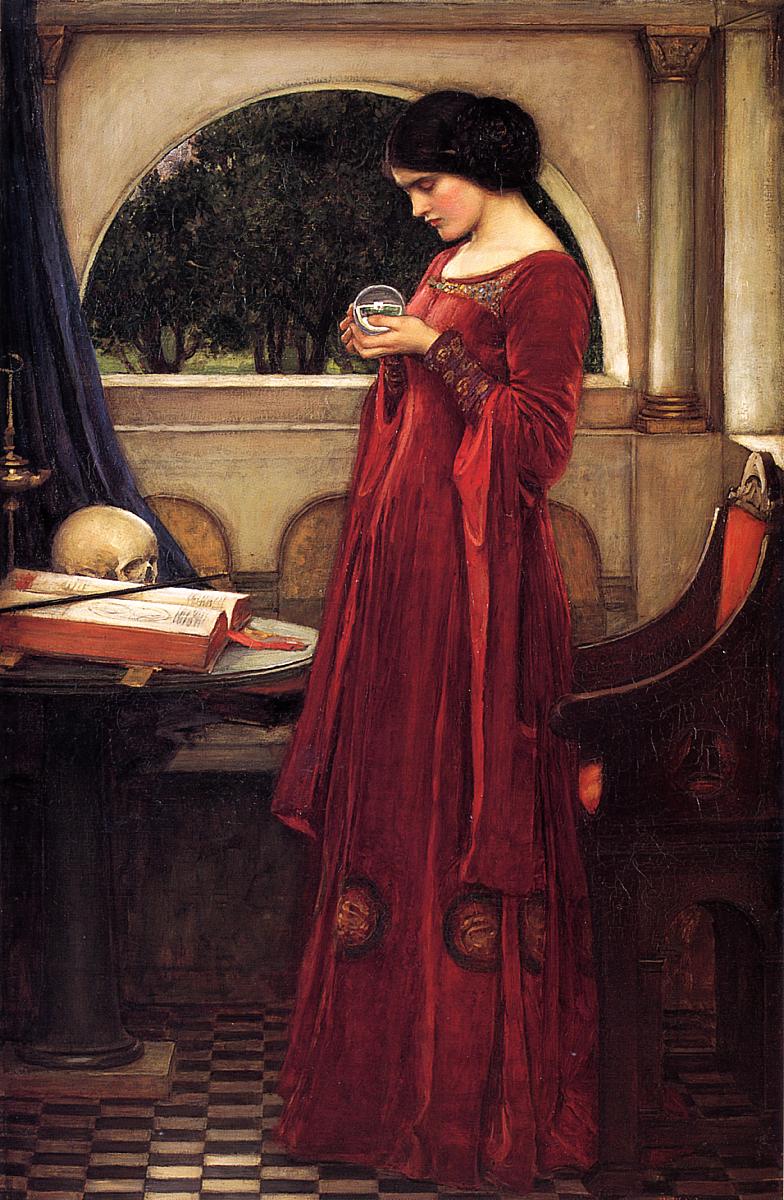
John William Waterhouse - The Crystal Ball.JPG
Making predictions

By John William Waterhouse - http://uploads6.wikiart.org/images/john-william-waterhouse/the-crystal-ball-1902.jpg http://www.wikiart.org/en/john-william-waterhouse/the-crystal-ball-1902, Public Domain, Link

Thursday, September 3, 2020

Action at the Margins

Prices are determined at the margins. What's meant by this is that the market price of any good is determined by the latest transaction in that good. It does not matter whether the vast majority of market participants think the price is wrong. As long as there are participants engaging in trade, they set the price. When buyers or sellers are satisfied at a given price, prices adjust to encourage the next set of transactions. If sellers disappear, prices go up so as to encourage new sellers to transact. If buyers disappear, prices go down so as to attract new buyers.

What's interesting to note is that action happens only as long as there are marginal actors. If buyers stubbornly insist on lower prices while sellers stubbornly insist on higher prices, there will be no transactions.

This mechanism is glaringly obvious in markets. However, it extends into all sorts of activities. Social interaction only happens when everybody feels that they gain from it. That's why there's virtually no social interaction between die hard conservatives and die hard progressives. Such people tend to prefer the company of their peers. They'd rather preach to each other in the comfortable knowledge that there will be no opposition. Alternatively, they will engage their intellectual adversaries in hostile verbal exchanges.

The market place of ideas is in this way just like the market place of goods and services. The bulk of potential interaction is simply waiting for the right moment to act. The only activity of any importance is at the margins. There might be large scale protests and manifestations. But none of this serves to convince anyone of anything. They merely confirm pre-set notions. Very few people ever find themselves greatly influenced by such events. They only serve to polarize society further, so much so that all interaction between rivalling ideas come to an end in much the same way trade halts when sellers and buyers cannot come to any agreement.

This means that anyone with an ambition to change society should do so subtly and carefully. Going all in with our most extreme views will not convince anyone except the few who already agree with us. Marches and manifestations are equally useless. Way more effective is to teach by example. Be subtly subversive in all that we do. Show the world that we are not afraid, and largely unimpressed by rules and regulations. By wearing our masks sloppily and enjoying the outdoors, we let everybody know that we're not afraid. By choosing home schooling over formal schooling, we show the world that we value liberty. As Albert Camus once said: The only way to deal with an unfree world is to become so absolutely free that your very existence is an act of rebellion.

Nothing beats life itself when it comes to influencing people. Instead of arguing and petitioning for change, we must be the change. Our every interaction with others should be an example of how good life can be. It's only when such marginal interactions gain traction that real revolutions happen. Every other approach is merely beating about the bush with no real change as a consequence.

Albert Camus, gagnant de prix Nobel, portrait en buste, posé au bureau, faisant face à gauche, cigarette de tabagisme.jpg
Albert Camus

By Photograph by United Press International - This image is available from the United States Library of Congress's Prints and Photographs division under the digital ID cph.3c08028. This tag does not indicate the copyright status of the attached work. A normal copyright tag is still required. See Commons:Licensing for more information., Public Domain, Link

The 5 Minutes a Day School

When it comes to home schooling, there's only one common goal that every child has to fulfil. That is the successful completion of whatever bureaucratic requirements are set up by the state. Apart from that, parents are free to craft the child's school day in any which way they please.

There is very little time required for the child to achieve the required goals. One look at the requirements give us the impression that much is already known and understood by our boy, and the rest is easy to teach. Furthermore, much can be taught without much direction from us. Our boy is passionate about YouTube and online games, and is therefore fluent in both his first and second language. Very little additional counselling is required. Five minutes of structured work per day, on average will probably suffice.

By making the structured work as trivial as possible, we teach our boy what may be the most important lesson of all, namely to take control of his own learning. There is no lack of curiosity with him, so it's not like he will learn nothing if left to his own. The other day, he was playing around with an HTML editor. For an 8 year old kid, that's pretty advanced. He is also reading and writing well due to his eagerness to figure things out. The only things we have to keep an eye on are the parts in the curriculum that he does not pick up on his own through his everyday activities. That's trivial in comparison to what he learns on his own.

Another thing that we help him with is his out of school interests and activities. We invite friends over every now and again to keep him from getting isolated, and we have registered him with an artist and a dance teacher so that he can get professional guidance with his two non-academic passions.

From this, our boy gets a taste of a lifestyle that we value very much ourselves. It is low in consumption and high on liberty. My intention is to teach my boy how to maintain this lifestyle for himself so that he will be as sovereign in his life as I am. That way, he'll be able to pursue any interest he might have, safe in the knowledge that he will never run out of money. If he makes money doing what he loves, he'll know how to save and invest his profits. If he pursues interests with no income, he'll nevertheless have enough money to keep him afloat through careful management of his inheritance.

From this it's clear that the ultimate lesson to be gleaned from home schooling is liberty, and with evermore people pursuing this type of education for their children, liberty will become evermore accepted and valued. Adding to this that no more than a few minutes of structured education every now and again is sufficient to achieve this end goal, liberty for all who want it is virtually guaranteed. 

Fireside Education frontispiece.jpg
Fireside Education

By Transferred from en.wikibooks to Commons by Adrignola using CommonsHelper. Originally uploaded to en:Wikipedia in November 2006 (log) by Darentig (talk)., Public Domain, Link

Wednesday, September 2, 2020

Paradoxes

Paradoxes are entertaining riddles that makes education fun. I've therefore decided to use one of Zeno's paradoxes to illustrate some interesting aspects of mathematics for my son. Starting with some basic maths related to infinite sequences, we see that not all such sequences end up with infinity. An infinity of consecutively smaller numbers end up with a finite number.

Many paradoxes can be solved with this bit of insight. When we deal with motion by dividing space into increasingly smaller parts, we divide time into correspondingly smaller parts. What we end up with is not an infinite time, but a finite time. The paradox disappears, because we see that all that is said is that a finite distance will be traversed by a moving body in a finite amount of time.

However, there is nevertheless something fundamentally interesting about these paradoxes. They seem to indicate that infinitesimally small subdivisions do not exist. Both space and time appear to be atomic in nature, as suggested in my aether physics. At some point, subdivision is no longer possible, and the full length of atomic space and time must be traversed, rendering the paradox invalid.

Zeno Achilles Paradox.png
Achilles and the tortoise

By Martin Grandjean - Own work, CC BY-SA 4.0, Link

Tuesday, September 1, 2020

Power, Greed and Conformity

We live in confusing times. All sorts of nonsense is spewed out as the truth, and anyone doubting it is a denier. The critical thinker is labelled a conspiracy theorist, while mindless conformists are haled as enlightened guardians of science.

It's easy to conclude from this that there must be some sinister agenda somewhere. That it's all been carefully planned. However, there's a far more likely explanation that requires no secret meetings of men with sinister intensions. All the nonsense we are witnessing can be explained in its entirety through an understanding of the corporate structure of modern economic affairs.

The corporate economy is a form of feudalism in which special privileges are handed out to certain companies in return for loyalty and tax collection. It is in essence a marriage between business interests and government.

This structure attracts individuals lusting for power and easy money. It also encourages conformity in thought and action. The power hungry tend to drift up through the halls of government, and the greedy drift towards the top of corporations. To stay inside, loyalty to the boss is essential. No original thought can be expressed. It must all conform to the ideas dominating the top of the structure.

People with original thought and a craving for liberty will tend to drop out of corporate structures. Only those who truly lust for power and money make it to the top, and only if they fully understand the importance of blind loyalty, and the general mechanics of mindless obedience.

This is inherent in the corporate structure itself. Once established as the dominant political-economic structure in society, no further collaboration is required in order to produce the sort of insanity that we are currently witnessing.

With the top of the political structure dominated by power hungry individuals, laws and regulations will tend to become increasingly restrictive over time. In the choice between liberty and tyranny, the power hungry will choose tyranny. If science can support their decisions, that's all for the better. Generous grants are therefore extended to universities that come up with liberty bashing ideas. Science becomes in this way a cover for the power hungry. All sorts of laws and restrictions can be passed based on "facts".

Universities, which are themselves corporations, are controlled by individuals who are both greedy and power hungry. The money coming from government is welcomed. Totalitarian ideas are promoted because they tend to please the power hungry. All sorts of studies are produced in support of tyranny, so that government funding will continue. Anyone objecting to this is pushed out. Opposition is not tolerated.

News media are corporations too, and will as such tend towards tyranny. Power and greed is the ruling principle. Conformity and clever thinking in support of ideas circulating at the top is rewarded. Nonsensical "facts" are spewed out as being supported by "science". Intelligence among journalists is only rewarded when used to push the accepted narrative. No original thought is allowed.

Corporate industries are no exceptions to this. What matters is money and power. If money can be made without production, that's seen as a bonus, not a problem. Subsidies directly from government or indirectly through cheap credit from central banks are seen as legitimate income streams, and are often valued higher than income through production of goods and services.

This has led us to the current situation where we are told all sorts of stories about viruses and climate that have no anchor in reality. To deny the official narrative is to deny "facts" and "science". Only blind compliance is seen as enlightened.

When faced with the flu of 2019, politicians chose overwhelmingly tyranny over liberty, and there were no serious criticism to be heard because the decisions were based on "science". We were told the "fact" that no liberty can be tolerated in face of grave danger.

The economy had to be turned off, which served the corporate interest at the expense of everybody else. Corporations ride out this storm with subsidies and access to cheap credit, while competitors go bankrupt. The bankrupt enterprises are subsequently bought up at the cheap or let to rot. Either way, it's a winning strategy for the greedy.

This is where we are right now. However, this way of doing things is unsustainable. A society where money is made without production is doomed. Furthermore, when rules are made mainly out of a lust for power, and intelligence is used solely to navigate the system, there's no way out. We're headed for disaster. The current corporate structure will not simply reform itself and continue. It will collapse.

Only those in possession of gold or productive land will get through the mess relatively unscathed. Everyone else will suffer tremendously, especially those hopelessly dependent on the current system.

Apocalypse vasnetsov.jpg
Power and conformity yields hunger and death

By Viktor Mikhailovich Vasnetsov - http://lj.rossia.org/users/john_petrov/166993.html, Public Domain, Link