Showing posts with label gravity. Show all posts

Wednesday, November 12, 2025

Mass as Aether Interaction

Mass is a central concept in physics. Yet, when people go looking for it by smashing matter into bits, they find nothing but neutral or charged fragments.

It's almost as if mass is hiding somewhere. But where could that be?

Conventional physics

In conventional physics, space is but an empty void. So, the only place to look for mass is inside matter. But decades of looking has revealed nothing.

Some may say that the Higgs Boson is where mass is hiding. But the evidence for this is far from conclusive. So, mass is conventionally thought of as something fundamental to matter. Wherever there is matter, there is mass.

No further explanation is given.

Aether physics

However, in aether physics, space is not an empty void.

Space has many properties. Among other things, it interacts constantly with matter. So, space is taken into consideration in all matters related to kinetics.

From objective analysis we find that there are three distinct types of acceleration. All of them adhering to Newton's formulas, where mass is fundamental.

These accelerations are:

As we will see, all of these accelerations involve the aether in different ways. Yet, there's a common denominator that makes them identical for purposes of calculations, and this common denominator is what we refer to as mass.

But there is no mass as a thing of its own in the real world. In aether physics, mass is but an abstraction derived from the fact that aether interacts with matter.

To see how this works, we need to look closer at how matter interacts with the aether.

Linear acceleration due to directly applied force

Of the three accelerations mentioned above, acceleration due to directly applied force is the only one that adds energy to matter.

Angular acceleration and acceleration due to field forces don't add energy.

This is because only direct force requires particles at the subatomic to change in size, and hence energy, in order to accelerate. So, adding energy is a necessary part of this type of acceleration.

This is done by the help of the aether, which is limited by the speed of light in order to perform this task. So, we get a time delay between applied force and increase in energy.

This time delay is experienced by us as a resistance to change. Also known as inertia.

So, when we make calculations related to inertial mass, we are in fact dealing with the time delay caused by the aether's inability to act instantaneously.

Angular acceleration

When a moving object is tethered to a central point, either by a string, or by the use of a field force, it undergoes acceleration. But no energy is added or subtracted to the object.

Yet, there's a measurable force involved, and it equates to what we would have to apply in order to achieve linear acceleration of the same magnitude.

So, there's something fundamental going on that connects linear acceleration directly to angular acceleration.

This too must be due to the aether's inability to act instantaneously. But with no energy being added, the mechanism involved must be different.

We cannot use the analogy of a pressure wave in the aether.

But we can nevertheless explain this in terms of matter interacting with the aether. Because all moving particles come with an accompanying pilot wave.

In the case of angular acceleration, there is no pressure wave. But there is a pilot wave, and it too is limited by the speed of light.

The constant need to change the direction of pilot waves, and influence associated particles accordingly, produces the exact same delay as pressure waves.

We can therefore use the concept of inertial mass to make calculations related to both linear and angular acceleration.

Linear acceleration due to applied field forces

In aether physics, the three field forces, magnetism, the electric force, and gravity, have one common denominator. They all operate through manipulation of the aether.

Repelling forces come about when aether particles are drawn into the field between acting bodies, and attracting forces come about when aether particles are expelled.

But this produces no pressure wave. Nor is there any pilot wave involved. Because space itself is manipulated.

So, when an object moves freely under the influence of a field force it does so with its reference frame moving with it. As far as the object is concerned, it remains in a state of rest during its entire flight. It isn't before the object stops moving at the end of its journey that energy is released.

This makes acceleration due to field forces distinctly different from acceleration due to directly applied force, or angular acceleration.

But, we end up with the appearance of inertia nevertheless. Because field forces result in accelerations that are directly proportional to the volume of subatomic particles involved.

This volume is independent of how densely packed the particles are. So, there's a direct relationship between acceleration due to applied field forces and other types of acceleration. Because they too are directly related to the number of particles involved.

Conclusion

Mass isn't something inherent to matter alone. There's no mass inside particles. Rather, mass is an artifact of the aether interacting with matter.

However, as long as scientists deny the existence of an aether, people will keep looking into matter in search of some elusive mass particle that simply isn't there.

Force examples.svg


By Force.png: Penubagderivative work: Arnaud Ramey (talk) - Force.png and File:Compound_pulley.svg, Public Domain, Link

Monday, November 10, 2025

Field Forces and the Aether

In aether physics, the three field forces; magnetism, the electric force and gravity; all operate through manipulation of the aether.

Zero-point particles are pumped into or out of the field between active objects, which causes these objects to move.

Particles as bundles of strings

But inertial matter is largely transparent to aether particles. The only thing opaque about electrons and protons is the strings from which they are made.

So, when the aether acts on particles of inertial matter, it is only interacting with strings. Because every other characteristic of matter is invisible to it.

The surface area, shape, density, chemistry, or any other higher level property of matter is of no importance.

As far as acceleration goes, the only thing that matters to field forces is the total volume of strings involved. 

Field force acceleration

This means that field forces act on volumes of strings rather than surface areas, or other characteristics of particles.

So, the acceleration produced by a field force is proportional to the volume of aether flux, divided by the total volume of strings involved:

  • a ∝ af/sv, where 'a' is field force acceleration, 'af' is aether flux, and 'sv' is string volume.

This can be tested against what we know about field forces to see if it holds up against scrutiny.

Tests

In the case of magnetism, we know that a magnet of a certain strength will accelerate at a corresponding rate, dependent only on how massive it is. The more massive the magnet, the more sluggish its acceleration relative to a less massive magnet of the same strength.

This fits well with our formula, because the more massive magnet has more particles in it, and therefore a larger volume of strings.

The same goes for the electric force. It too accelerates objects depending on aether flux and string volume.

As for gravity, there are no inactive particles involved. Because any addition of strings, in the form of inertial matter, result in a corresponding change in aether flux. So, acceleration due to Earth's gravity is the same for all objects, regardless of shape and density.

Inertia is not part of the equation

Note that there is no mention of inertia in all of this.

This is important because inertia is defined by us as a time delay related to energy transfers.

But for free falling objects under the influence of gravity, magnetism or the electric force, there's no energy transfer. So, inertia, as it is defined by us, cannot be part of our equation.

Mass is not part of the equation either

Similarly for mass, which we view as a mere abstraction, we make no mention of it.

So, once again, we've been able to describe phenomena related to matter and acceleration with no mention of mass.

Conclusion

The three field forces; magnetism, the electric force and gravity; can be explained without any mention of mass.

This goes hand in hand with our definitions of inertia and matter, which are also without any mention of mass.

We remain therefore confident that mass is but an abstraction, useful in calculations, but with no direct existence in the real world.

Magnetic field of horseshoe magnet.png

By Frank Eugene Austin - image had initials 'F.E.A.' in lower left corner. - Downloaded August 25, 2008 from Frank Eugene Austen (1916) Examples in Magnetism, 2nd Ed., Hanover, N.H., USA, p.31, plate 2 on Google Books, Public Domain, Link

Saturday, November 8, 2025

A Theory of Matter that does not Include the Concept of Mass

The concepts of inertial and gravitational mass are central to conventional thinking related to matter. Especially the principle of equivalence, which states that the two types of mass are the same.

However, our alternative theory of matter doesn't include mass as anything but an abstraction. Instead, of mass, we have particles with positive and negative charge. Yet, our theory yields identical results to conventional ones.

To see why this is so, we need to compare conventional theory to our alternative.

Inertia

Inertia is conventionally defined as resistance to changes in velocity. No further explanation is given.

However, in our alternative theory, we have an explanation.

Inertia is due to the fact that it takes time to transfer energy from one object to another. So, we end up with a mismatch between the pressure we apply and any consequent change in motion. The delay comes across as resistance.

Energy

Energy is another property that's poorly defined in conventional theory. It's simply a property related to matter and particles like photons.

However, in our alternative theory, energy is defined as surface area at the subatomic. Energetic particles are larger than less energetic particles of the same kind. So, when energy is added to an object, the total surface area of its subatomic particles increases.

With more surface area to cover in order to transfer energy, the time required to do so goes up, and hence we get an increase in inertia.

Gravity

Gravity is conventionally thought of as a force proportional to the masses involved. So, when inertia increases due to more matter, gravity increases to the exact same degree. The acceleration due to gravity is therefore identical for all objects, no matter their size or shape.

However, this too lacks any good explanation.

But in our alternative theory, gravity is due to an imbalance in the electric force. Repulsion between equally charged particles is a tiny bit less strong than attraction between opposite charged particles.

For massive objects, this minuscule imbalance adds up to a measurable force that's always attracting, and it is this force that we call gravity.

This force is proportional to the number of charged particles involved at the subatomic. So, we end up with the same conclusion as the one derived from conventional thinking. The more matter we have, the more gravity we get.

Proportionalities

So, in our theory, we have inertia as something proportional to energy.

Adding energy to an object results in more inertia.

However, gravity is unaffected by energy. Because it's related only to the total number of charged particles involved. The number of charged particles we have at the subatomic remains the same regardless of how much energy we have.

So, when energy is added to an object, inertia increases while gravity remains the same.

Inertia and free falling objects

From this, it appears that we must conclude that energetic objects fall at a slower rate than less energetic objects of the same kind. Because the energetic objects have more inertia, so it's harder for gravity to pull on them.

However, this ignores the fact that no energy is transferred to or from objects in free fall. Inertia, as it is defined in our theory, has nothing to do with free falling objects. It's only when these objects hit the ground that energy is transferred to other objects.

So, gravity is an acceleration more than it is a force. Hence, the principle of equivalence, proposed by Einstein.

The aether

Einstein concluded in his work that space-time must be curved, and that this curvature is proportional to the masses involved.

This is equivalent to our alternative proposal, which involves an aether.

The idea is that gravity is due to aether escaping from in between gravitational objects. This produces a low pressure of sorts that draws objects together.

But this low pressure is not produced by the elusive entity that we call mass. It depends instead on the number of charged particles involved at the subatomic.

With no change in charge when energy is added to matter, the acceleration due to the aether remains unchanged.

So, here again, we see that our model produces results identical to what we get with models based on mass.

Conclusion

There's no need to conjure up an elusive concept called mass in order to explain inertia and gravity. Because a theory centered around charges and the size of particles at the subatomic gives the exact same results.

Scale for measuring weight


By M.Minderhoud - White Background by Amada44, CC BY-SA 3.0, Link

Saturday, September 20, 2025

Dimorphos and Didymos revisited

Three years have passed since NASA’s DART probe hit the asteroid Dimorphos. An impact that shortened its orbit around its parent asteroid Didymos by ten minutes.

Successful mission

The result was well within what NASA had predicted, and was therefore considered proof of concept for the kinetic impactor method. However, a study of debris ejected by the impactor shows that large fragments are moving faster than expected.

Something is a little off relative to their theory.

Erroneous predictions

On the other hand, I made two predictions that have not come true. One about the composition of the asteroid, and another one about its change of orbit.

I was also under the misapprehension that the goal of the impact was to widen the orbit. But my prediction had to do with changes to the orbit, independent of whether they are made wider or shorter. So, this is not a big deal.

My main point was that the orbit would be less impacted than predicted by NASA, and that the orbit might even be partially or fully restored to its original after a few years.

This didn't happen. But the reason for this may be found in the unaccounted for energy observed by NASA.

Stability of orbits

My position when it comes to the stability of orbits is that the role of static electricity is underappreciated by astronomers.

Gravitational attraction and electrostatic repulsion

The two bodies involved in an orbit are both negatively charged. My thinking is therefore that the impact on the smaller body should've been partially countered by the force of electrostatic repulsion. The combination of gravity and the electrostatic force should've mitigated the impact of NASA's probe in much the same way that a shock absorber overcomes mechanical shocks to cars.

Ejected fragments

But if a large number of fragments are ejected from the impacted object, much of that object's initial charge is lost. This is because charge resides mostly at the surface. The shock absorber is damaged, as it were. Much of the repelling force that existed in Dimorphos before the impact was taken over by fragments.

The fragments, highly charged as they were, got in this way an extra boost. Once released from the surface of Dimorphos, they accelerated away from Dimorphos and Didymos with more energy than predicted by NASA.

The net result of this was that NASA got the smaller orbit that it predicted, but also the more energetic fragments than it predicted.

My prediction, on the other hand, failed because the fragments took away the shock absorber effect that I had expected to see.

Had Dimorphos remained intact, with little to no debris ejected, my prediction may well have come true.

Jupiter's Children

An interesting aspect of this is that the ejection of debris from Dimorphos is similar in form to the theory that Jupiter ejects moons whenever it is sufficiently stressed to do so.

Jupiter ejecting a moon

The idea is that Jupiter will eject a moon every now and again, and that this happens with the assistance of electrostatic repulsion.

Once a blob of matter is pushed sufficiently high up, electrostatic repulsion kicks in, and the blob is thrown into space.

This explains the large number of moons orbiting large planets like Jupiter and Saturn. It may even explain Venus' odd behavior and apparent recent arrival in our solar system.

Objects thrown into space by parent objects gain extra energy from electrostatic repulsion.

However, this doesn't explain Dimorphos composition, which is different from what I had expected.

Bundle of rubble

As it turned out, Dimorphos was not the solid rock that I thought it would be. It was a bundle of rubble instead, which begs the questions. How was this assembled? Which force pulled it all together?

My position is that gravity is too weak to pull dust and rubble into lumpy asteroids. I'm not a big fan of the accretion disc theory. But the composition of Dimorphos seems to confirm this model. It can be argued that Dimorphos is the result of millions of years of steady growth due to gravity.

However, we can equally argue that the process of assembly is driven by static charge. Neutral bodies are attracted by charged bodies. Dust sticks to charged balloons. The phenomenon is well known. It's also a lot stronger than gravity.

Conclusion

The experiment performed on Dimorphos by NASA has taught us a lot about asteroids and orbits. But it has not provided conclusive evidence one way or another when it comes to the various theories related to this. All we can say is that the gravity only model is at a loss when it comes to explaining the extra energy evident in debris ejected by Dimorphos. Our competing mode, on the other hand, is only kept standing precisely because there was excess energy transferred to the debris.

Sunday, December 8, 2024

Atlantis, the Igloo Effect, and Mass Extinctions

Introduction

The legend of Atlantis is an enduring myth that may have more truth to it than is generally believed, because its existence would go a long way in explaining how ancient building techniques and religious symbols all over the world are as similar as they are.

Places as far separated as Peru, Mexico, Egypt, Mesopotamia, India and Cambodia, all have ancient building structures that are remarkably similar. They also have gods carrying handbags and displaying other symbols that are virtually identical in all these places.

At the very least, these places must have been connected by a network of trade and cooperation.

Not a new idea

The illustration below shows us that this is not a new idea. People have been speculating about Atlantis for a long time, and this particular map is a good example of this. However, it contains some glaring errors.

If Atlantis existed some twelve thousand years ago, Scandinavia would have been under a thick layer of ice, and so would the northern parts of North America.

On the other hand, East Asia should have been included. If not as a part of the Atlantis empire, then at least as an important cultural and economic connection.


Position and extent of Atlantis and its empire, postulated by Ignatius L. Donnelly in 1882

By Ignatius Donnelly; cropped by Beyond My Ken (talk) 22:14, 28 September 2010 (UTC) - This image is available from the United States Library of Congress's Prints and Photographs division under the digital ID cph.3b36915.This tag does not indicate the copyright status of the attached work. A normal copyright tag is still required. See Commons: Licensing for more information., Public Domain, https://commons.wikimedia.org/w/index.php?curid=11626443


Remarkable accuracy

However, what's remarkable about this map is not its errors and omissions, but the fact that the island of Atlantis is drawn in at a location that would in fact have been dry land at the time of Atlantis' supposed existence.

The author of the map could not have known this for sure because the map was drawn before our ocean floors were mapped out. At most, he was aware of the Acores, which are today found in the region. But the landmass is drawn into the map, not because of the Acores, but because this is where Plato in his time said that the island was located. That's more than two thousand years ago.
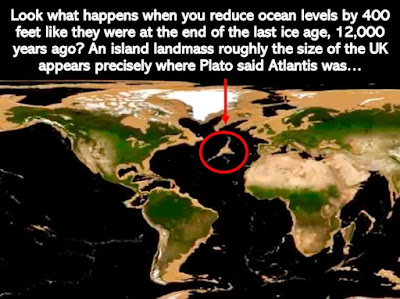
Atlantis

Strategic location

If a dominant civilization existed at the end of the great ice age, we can hardly imagine a better location for its center.

The island of Atlantis was large enough to sustain a civilization, it was near impossible to invade due to its surrounding seas, and its central position on the map would have made it a perfect spring board for imperial expansion. So, it's clear that this part of the legend has merit. But could the island really have sunk into the ocean in as little as a night and a day, as claimed by Plato?

More than an earthquake?

While it's possible to imagine an island the size of England sinking into the ocean due to an earthquake, evidence suggests that this didn't happen, because if it did, the reconstructed map should show no land at the location of Atlantis.

So, for this part of the legend to be true, the oceans must have risen abruptly.

But conventional theory has it that the oceans have risen slowly and steadily over thousands of years due to a steady melting of the ice caps.

Some catastrophes are known to have happened, such as the flooding of Doggerland in the North Sea some ten to twelve thousand years ago. But all in all, sea levels have moved higher without much in the way of catastrophe.

Sundaland, in East Asia, is another area that is known to have sunk into the sea with rising sea levels, and some have suggested that the legend of Atlantis is merely a reference to places such as Sundaland and Doggerland. But these places are not where Plato puts Atlantis. Nor is it a given that these areas disappeared slowly rather than catastrophically. We merely assume that sea levels rose steadily over centuries because that's how great volumes of snow and ice melt.

However, if large amounts of land ice were to slide into the oceans, there would be catastrophic floodings without any exceptional melting going on, and this could happen very quickly.

Icesheet slippage

For instance, if the current Greenland icesheet slid into the Atlantic ocean, there would be a huge tsunami, followed by a permanent sea rise of up to 7.4 meters. So, if something like that happened in the past, we would have had a situation similar to the one described by Plato.

The strong earthquake that rocked Atlantis, according to Plato's story, may have triggered an icesheet slippage relatively close by, which would have caused a tsunami to wipe out most of the island. Shortly thereafter, there'd be a catastrophic flooding of Doggerland, and this would in turn be followed by a global rise in sea levels, affecting low-lying lands everywhere, including Sunnaland.

So, when the few survivors from Atlantis returned to their island to look for it, they would have found it permanently sunken into the sea. Instead of dry land, they would have found shallows and islands, like Plato said they did.

Rapid disappearance of icesheets

This scenario, if sufficiently large scale, or repeated several times, would have greatly accelerated the melting of the ice caps, because water is a lot more effective than air in melting snow and ice. Instead of air and sun melting the ice over tens of thousands of years, the icesheets would have disappeared within a few thousand years, which is what appears to have happened, based on geological records.

Icesheet slippage can therefore explain how the enormous icecaps of the great ice age came to disappear as quickly as they did. But by what mechanism would this have happened?

The igloo effect

A phenomenon rarely considered when it comes to truly enormous icesheets is what's known as the igloo effect. Yet, this mechanism may be key to understanding why great ice ages tend to come to sudden and catastrophic ends, where ice that has accumulated over tens of thousands of years disappear in a tiny fraction of this time span.

To understand this, we have to recognize that ice and snow are insulators that prevent heat from escaping. For example, the inside of an igloo can be a great deal warmer than outside temperatures, even with a relatively small heat source at its center.

The same goes for icesheets where the temperatures close to the ground can be a great deal warmer than at their surface, because Earth itself is a heat source. In fact, once an icesheet becomes sufficiently thick, temperatures at ground level may go permanently above freezing. Instead of being anchored to the ground through frost, the icesheet comes unglued.

Sitting on top of large pools of fresh water, the icesheet becomes unstable and liable to slip, because ice is virtually frictionless when pressed against a wet surface.

Planetary expansion

Once an icesheet looses its anchoring, a large chunk of it can break loose and slide into the ocean. All it takes is a sufficiently strong earthquake for disaster to ensue. It's therefore interesting to note that there's evidence to suggest that our planet is expanding, and that this happens in fits and starts that coincide with ice ages.

Furthermore, Earth's expansion is lopsided, with the Pacific region expanding faster than the Atlantic. A consequence of this is that Greenland, Canada and Scandinavia have moved southwards from where they were located at the start of the last great ice age.

This explains why it was Canada and Scandinavia that together with Greenland held the bulk of ice on the northern hemisphere during the last great ice age, and why northern Russia was less affected. It also suggests to us that Canada and Scandinavia may have shed their icesheets, largely or in part, by slippage into surrounding waters.

Mass extinctions

There also appears to be a relationship between the size of our planet and the maximum size of land animals. Not only were dinosaurs larger than the mammals that followed them, but ancient mammals were larger than mammals are today, and the same goes for birds. Furthermore, mass extinctions happen periodically, and the latest episodes coincided with what was presumably the latest fits of Earth expansion some twelve and four thousand years ago.

Researchers, such as Stephen Hurrell, have pointed out that mass extinctions are likely due to an increase in gravity that correspond to an increase in the size of our planet. So, it wasn't climate change or human activity that killed off the Saber Tooth Tiger, the Giant Sloth and the Woolly Mammoths. Rather, it was an increase in gravity that did this, coupled with an inability by these animals to respond sufficiently quickly with smaller offspring.

On the other hand, large animals that managed to produce smaller offspring have survived to this day. The African lion being a prime example of this.

This too fits well with the legend of Atlantis where Platon implies that animals at the time were larger and more voracious than they are today.

Conclusion

The legend of Atlantis dovetails well with a number of observations and theories related to the history of our planet. Every aspect of the story can be explained, including the island's sudden and dramatic demise. But the only way to conclusively find out if the legend is true would be to survey its supposed location for human artifacts. Until that happens, we must treat this legend with the same skepticism that we treat any other legend or theory.

Thursday, July 11, 2024

Plasmoids and Z-pinches

Once we accept the fact that we live in a plasma universe, we soon come to realize that self-organizing structures such as plasmoids and z-pinches can explain a great number of astronomic observations. For one, we can explain galaxies without any need to invoke dark matter, dark energies or black holes.

Plasmoids

A plasmoid is a coherent self contained structure of plasma that typically takes on the form of a torus. An internally generated magnetic field holds it together, and keeps it from collapsing into a ball.

The magnetic field is generated by plasma currents inside the torus which in turn contain the plasma and perpetuate the current. Hence, we end up with a self contained structure that will persist for some time even after its energy input is shut off.

Galaxies as plasmoids

Laboratory experiments involving plasmoids reveal structures that look a lot like galaxies, and it has therefore been speculated that galaxies are in fact plasmoids.

Initial thoughts in this direction proposed gravity as the driving force behind the galactic current required to keep the plasmoid from collapsing.

A black hole is often imagined at the center of galaxies. However, the existence of intergalactic currents makes the need for a gravity driven input redundant because intergalactic currents will naturally produce z-pinches that are just as strong as black holes.

Z-pinches

A z-pinch is a plasma phenomenon that serves to compress a plasma. This can be achieved in a laboratory by running currents in parallel, or through magnetic manipulation.

From the look of it, galaxies appear wherever there's a z-pinch in the intergalactic current. Hence, we have good reasons to believe that what is presumed to be black holes are in fact z-pinches.

Since the effect of a z-pinch is to pull plasma together, there's no need for a strong gravitational force at the center of galaxies in order to explain their shape. Z-pinches will do just fine.

Black holes vs z-pinches

Unlike z-pinches, no-one has ever produced a black hole in a lab. The concept of a black hole is wholly theoretical.

Black holes were conceptualized from a feature in Einstein's equations where densities and temperatures go towards infinity at certain threshold values. They are in other words the result of bad math, where values are allowed to be divided by zero. But this hasn't stopped astronomers from believing in their existence. Rather, the opposite is the case. Astronomers now claim to see black holes just about everywhere in the universe.

But what's really observed is plasma. There's no controversy related to that, because black holes can only be inferred from the radiation emitted from their surrounding plasma. The black holes themselves are not directly observed. What's observed is plasma in a torus shape.

This is of course exactly what a plasmoid would look like in space. Yet, astronomers refuse to give up on the idea of black holes even though z-pinches will suffice to produce the observed inward pressure.

Observation and theory

Plasma physics is based on observation and replication in laboratories. In plasma physics, theory springs from observation. This is in contrast to astrophysics where theory is primary, and observations only serve to confirm what has been deduced.

When observations conflict with theory, astrophysics will add whatever is needed in order to keep their theory alive. This is how dark matter and dark energies have come into mainstream astrophysics.

In contrast, plasma physicists are quick to give up on ideas that conflict with observations. If something hasn't been confirmed in a laboratory, theories are but speculations with little weight to them. There's no point in hammering through an idea that cannot be reproduced in a lab.

Of the two approaches, plasma physicists got things right. There's no point in going into details regarding theory that hasn't been readily confirmed. Ideas should be sketched out quickly and freely and quickly put to rest if not reproduceable in a lab. No-one should get too attached to a theory, and that includes the theory's author.

Developing theory

The theory of everything presented on this website was conceived and developed in a series of rapid iterations, and this is in my opinion the best way to produce good results.

I had the idea that everything in the universe might be explained with particles bouncing into each other to produce force and hooking up with each other to produce structures.

I tested this idea against a wide range of phenomena to see if it had any merit, and I was of course delighted to find that it held up to this initial scrutiny.

This first iteration took no more than a few weeks to complete, so I wouldn't have found it intolerably painful to abandon the idea had I come across unsolvable problems.

The second iteration served to shore up a number of loose ends. Then, there was a third iteration and a fourth iteration that resulted in the two books available on this website.

This has been followed by several refinements and a great number of blog posts.

Every iteration has taught me something new. I've found new insights, which is the whole purpose of writing theory. So, even if I should come across some insurmountable problem related to my theory, I would not have worked in vain. In fact, my experience would have value for others in their own search for a theory.

I would be more than happy to point out the pitfalls I fell into so that others can make progress without stumbling into them themselves.

Specialization

This is in contrast to how science is approached in academia these days. Instead of going for an overall view, academics tend to specialize early. Years of studies are invested in narrow fields, and this results in a reluctance to consider alternative views. Hence, we get the situation where black holes are preferred over plasmoids and z-pinches despite serious problems with black holes, both in theory and observation.

Conclusion

Science is in its essence nothing other than structured curiosity. It's not a place for closed minds. Hence, theory should never be taken too seriously. Alternatives should always be considered. At the very least, there should be a curiosity related to any alternative view of the particular field of expertise that a scientist is involved in.

However, career science isn't very open to alternative views. Rather, it's heavy on career and light on science.

Future breakthroughs in theoretical physics will therefore come from the fringes, and from the amateurs that think freely and unhindered by dogma.

Plasma jet ejected by a galaxy

By NASA and The Hubble Heritage Team (STScI/AURA) HubbleSite: gallery, release., Public Domain, https://commons.wikimedia.org/w/index.php?curid=102873

Thursday, June 27, 2024

How Gravity Differs from the Electrostatic Force

The electrostatic force and gravity have a number of differences that seem to indicate that these forces must be largely unrelated. However, on closer inspection we find that these differences are fully accounted for in a model where gravity is due to an imbalance in the electrostatic force.

Surface phenomenon vs universal phenomenon

The electrostatic force is always calculated from the surface of objects. This is because this phenomenon is due to an excess or deficiency in electric charge. Electrons stick to certain materials, and they can be rubbed off from other materials.

This happens exclusively on the surface of these materials. Hence, the need to calculate this force from the surface of materials rather than their center.

Gravity on the other hand, if due to an imbalance in the electrostatic force, must be calculated from the center of bodies. This is because an imbalance of this sort is additive. Every atom has this imbalance, so every atom has to be accounted for.

Newton's shell theorem proves that this must be so.

Dependent vs independent of material types

The electrostatic force acts differently on different types of materials. The chemical and physical properties of materials take part in determining the strength of this force.

This is due to the need for charge imbalances in order for this force to work. Materials that resist charge imbalances are therefore less affected by this force than other materials.

However, an imbalance in the electrostatic force will exist regardless of material types. If gravity is due to such an imbalance, all materials will attract each other.

It doesn't matter if a material resists charge imbalances, because the addition or subtraction of electrons has nothing to do with the inherent imbalance that exists in all materials. All that matters is the total number of electrons and protons involved.

Shielding vs no shielding

The electrostatic force induces charge imbalances on the surface of materials. This serves in turn as shields of various qualities. However, there's no way to shield a universal imbalance, because such imbalances are additive. It doesn't depend on the type of materials used.

Any gravity "consumed" by a concrete floor will be matched by gravity "produced" by the same floor. So, the floor doesn't take away any gravity from us as we sit upstairs, and this goes for any floor regardless of material used.

Conclusion

Gravity, if due to an imbalance in the electrostatic force, will result in a universally attracting force that acts from the center of objects, independent of material types. So, there's no reason to dismiss this idea simply because the electrostatic force acts differently.

Gravity vs the electrostatic force

Friday, June 7, 2024

How Gravity Relates to the Electric Force

Gravity is due to an imbalance in the electric force which makes electric repulsion a tiny bit weaker than electric attraction.

This means that Newton's law is in fact a variation on Coulomb's law, and we should therefore be able to establish a formal relationship between the two.

It's not enough to say that G is a proxy for k, and that M1 and M2 represent total charge while q1 and q2 represent net charge. However, it's a good starting point.

As we will see, the relationship between Coulomb's law and Newton's universal law of gravity can be formally quantified and explained.

Electric force and gravity
Coulomb's law compared to Newton's law

How G relates to k

First off, we need to realize that the two constants k and G are related in that they both transform an intermediate result into force. Both of the above equations yield result in Newton, and this is only because of k and G.

With the only other difference between the two equations being q1 and q2 vs M1 and M2, we should be able to find a relationship between these quantities simply by dividing G by k.

k and G have been measured to be:

k = 8.98755 10^9 kg m^3/C^2s^2 , where C is charge expressed in Coulomb

G = 6.6743 10^-11 m^3/kg s^2

Dividing G by k we get:

G/k = (6.6743 10^-11)/(8.98755 10^9) C^2/kg^2

G/k = 7.426 10^-21 C^2/kg^2

How G/k relates to inherent charge imbalance in matter

The thing to note about this result is that we have C squared divided by kg squared.

The reason for this is that we naturally get a square if we multiply q1 with q2 or M1 with M2. To get a result that relates one mass quantity to one charge quantity, we need to take the square root of G/k.

This yields the magnitude of the electric imbalance inherent in neutral matter. It relates matter expressed in kg to its inherent charge imbalance expressed in C, and we will call this value p for short:

p = (G/k)^1/2

p = 8.618 10^-11 C/kg

What this means

We can now use p to transform matter measured in kg into charge imbalance measured in C. For every 1 kg of matter, we have an imbalance of 8.618 10^-11 C.

If we put two neutral 1 kg masses next to each other, with only 1 mm of separation, we get a force corresponding to 0.067 mN.

To get a corresponding force by simply charging the two masses we need to add 538 million electrons to one of the masses and subtract 538 million electrons from the other mass.

This may sound like a lot, but there are 3.055 10^24 atoms in a kg of gold, and each atom of gold has 79 electrons. The total number of electrons corresponding to 1 kg of matter is therefore roughly 2.4 10^20 million electrons.

The imbalance in the electric force caused by 1 kg of matter is in other word a mere 5 10^-15 percent of the total number of electrons present in the material.

This means that a measurement in an electric lab has to be precise to 17 digits after the decimal point to even start registering the effect of gravity. No wonder then that gravity has never been measured in such a laboratory.

Our proxy is a variable

If gravity is due to a minuscule imbalance in the electric force, it's likely to be dependent on other electric factors as well, such as capacitance and charge. This makes p a variable rather than a constant, and by extension we get that G is a variable too.

It follows that two bodies don't necessarily have the same value for p. A small body with little capacitance will have a different p than a large body with a lot of capacitance.

From observations we can further infer that it is the large bodies that have the greatest values for p, because large bodies seem to be more gravitationally strong, relative to their sizes, than small bodies.

With this in mind we can put together a modified version of Newton's formula as follows.

Newton's formula expressed in terms of k and p

It's now possible to convert mass expressed in kg into a charge imbalance expressed in C. By multiplying p with M we get units corresponding to point charges and we can therefore express Newton's law as follows:

Newton's law expressed in terms of k and p

Instead of G, we get p1 and p2 which relate the masses M1 and M2 to their respective charge imbalances.

With this transformation in place, Coulomb's law can be used for both gravity and the electric force. These two forces have thus been formally joined together, leaving us with no need for the gravitational constant G.

Saturday, May 25, 2024

Vulcan and the Mercury Anomaly

Mercury makes its rounds around the Sun a little faster than predicted by Newton, and this has been a subject for debate in astronomy ever since this was discovered. However, the debate is currently considered settled by Einstein, who demonstrated that a curved space-time could account for the observed fact. But this doesn't mean that there are no alternative explanations.

Alternative explanations

I've presented two possible alternatives in my book, and Dr. Robitaille, who's an expert on astrophysics, has come up with an elegant take on the phenomenon that doesn't invoke anything outside of standard Newtonian mechanics.

Dr. Robitaille starts off by mentioning the hypothetical planet Vulcan that was proposed as a first attempt at explaining the anomaly back in the nineteenth century. The idea was that if there was a planet orbiting between Mercury and the Sun, this planet would pull Mercury with it, thereby speeding it up ever so slightly. However, the planet was never found, and the idea was abandoned.

But if the Sun has a blob inside of it so that the center of gravity is a little skewed we'll get the same effect. The blob rotates with the Sun, and whenever it passes Mercury, it gives Mercury a little tug. Vulcan may in other words exist, but as a blob inside our Sun rather than a planet orbiting it.

Jupiter's Red Spot

An interesting aspect of Dr. Robitaille's proposed blob is its similarity to Jupiter's Red Spot, because the Red Spot is in fact a blob. It has been measured to be gravitationally stronger than its surroundings. It stands taller than the surrounding atmosphere, and it's becoming more circular and compact.

However, the Vulcan blob is not visible at the surface of the Sun. If it exists, it's located somewhere below the Sun's surface. But apart from that, the blob and the Red Spot have a lot in common, so if the Red Spot is an embryonic moon of Jupiter, could it be that the Vulcan blob is an embryonic planet that might one day be ejected by the Sun?

Jupiter ejecting a moon

Friday, May 10, 2024

Gravity on Mercury

Fossil remains indicate that Earth's surface gravity was about one third of what it is today back in the days of the dinosaurs, and geological analysis of our planet indicate that Earth' diameter has doubled in size since these same dinosaurs were alive.

It appears then that surface gravity on rocky planets like Earth triple in strength when their diameters double due to expansion.

Any rocky planet, half the diameter of Earth, that has undergone little to no expansion, should therefore have a surface gravity roughly one third of what we have here on our planet.

As it turns out, we have a nearby planet that shows few signs of expansion, with half the diameter of Earth, and a geological makeup also similar to our planet, and its surface gravity is in fact roughly one third of what we have here on Earth.

That planet is Mars.

The numbers are as follows.

Relative diameter:

6,779km / 12,742km = 53%

Relative surface gravity:

3.7 / 9.8 = 38%

So far, so good. However, when we do the same calculations for Mercury, we get the following.

Relative diameter:

4,880km / 12,742km = 38%

Relative surface gravity:

3.7 / 9.8 = 38%

In this case, the difference in surface gravity is what we'd expect from Newtonian theory, namely a linear increase with diameter.

Seen from a Newtonian perspective, Mars is the odd one out. It has for some reason a less dense interior than Mercury and Earth. But mainstream science also holds that Earth's core has "puzzling structural complexities". Earth's interior is becoming incredibly complex, especially compared to Jan Lamprecht's model which he developed from the same seismic data.

It may therefore be that it is Mercury that is the odd one out, and not Mars. Mercury may have a smaller hollow at its center than is the case for Mars, and Earth back in the days of the dinosaurs. It may also be that Mercury's proximity to the Sun is making it supercharged due to the photoelectric effect, with this in turn affecting its gravity.

We can only speculate at this point. But there's no need to blindly accept that Earth's interior is mindbogglingly complex, and not relatively uniform throughout, with diminishing density as we get closer to the center, as suggested by Mr. Lamprecht.

Mercury in true color.jpg
Mercury

By NASA/Johns Hopkins University Applied Physics Laboratory/Arizona State University/Carnegie Institution of Washington - https://photojournal.jpl.nasa.gov/catalog/PIA11364, Public Domain, Link

Friday, May 3, 2024

Black Holes and Unicorns

Dividing a number by zero yields what's known as a mathematical singularity. The result of such a division is not infinite, but undefined. In the context of the real world, the result doesn't exist.

Any theoretical formula about the real world will therefore have to omit any singularities that may arise. One would have to put limits on the proposed formula. Consequently, honest scientists should always look out for singularities in their formulas and point out that their formulas break down at certain values.

Singularities are like red flags. They inform us of boundary conditions. In the context of physics, singularities indicate that there are limits to how dense, hot or otherwise extreme something can become before some fundamental mechanism kicks in to rectify things. That fundamental property is in my opinion the aether which makes space quantized rather than linear.

This means that things do not change in a linear manner when things get extreme. For instance, the electric force becomes suddenly weaker when things get extremely close together. The same goes for gravity. Extremely dense objects stop behaving as expected from linear formulas.

However, all of this is conveniently ignored when it comes to astrophysics.

Black holes, also known as gravitational singularities, have properties that are infinite. They are infinitely dense and infinitely hot. They are in other words physical impossibilities, yet they are presented to us as real.

A reason for this may be that it's fun to talk about impossible things. Just like unicorns, we can all form opinions about them. Some even claim to have seen them, even taken pictures of them. Yet, everyone knows deep down that they don't exist.

Blackness of space with black marked as center of donut of orange and red gases

A picture of an astronomical unicorn, or something else entirely

Monday, February 13, 2023

How the Meganeura and Quetzalcoatlus Indicate that Inertia has Increased over Time

The Meganeura, which existed on Earth some 300 million years ago, was a dragonfly the size of a seagull. Its shape indicates that it was able to hunt for food in much the same way that dragonflies do this today. It must have been able to jump about in the air, turn on a dime and perform loops and similar displays of aeronautics.

Meganeura, lifesize model
(from Land of the dead blog)

The Quetzalcoatlus, which existed on Earth some 60 million years ago, was a flying dinosaur the size of a giraffe. Its shape indicates that it must have been able to hunt for food much the same way that pelicans do so today.


Quetzalcoatlus
(c) M. Witton via G. Trivedi

These are conclusions we can draw from Darwin's law which states that no animal will develop a shape that doesn't fit with its habits. If something looks like a dragonfly, it will act like a dragonfly. If something looks like a pelican, it will act like a pelican.

The first things that strike us when it comes to these animals is the size of them and the fragility of their wings. The Meganeura was able to fly like a dragonfly despite being the size of a seagull. That's remarkable, because a seagull is unable to perform dragonfly aeronautics despite having wings that are substantially stronger than what the Meganeura was equipped with.

As for the Quetzalcoatlus, no animal that size is able to fly, certainly not with bat-like wings. The biggest bat currently in existence weighs less than 1.5 kg, yet the Quetzalcoatlus was able to fly despite being the size of a giraffe.

The mismatch between the size of these animals and their ability to fly indicate that something dramatic must have happened. Gravity must have been lower. However, the mystery doesn't stop at gravity. Inertia must have been different too. This becomes clear once we consider the type of manoeuvring that these animals must have been able to perform.

Getting off the ground is but one problem that they had to overcome. It can be explained by suggesting that gravity was less strong. But once the Meganeura was off the ground its thin wings would nevertheless have been a problem. If it tried to turn on a dime, or suddenly jump one way or the other, its wings would break due to the stress of the change in momentum. The animal must have had a body with less inertia than what an identical body would have today.

The same can be said about the Quetzalcoatlus. If its head had the sort of inertia that such a head would have today, its neck would snap the moment it tried to do a pelican like flip of its beak.

This suggests that matter has become heavier in terms of both gravity and inertia since the time when these animals existed. We can use the Meganeura and Quetzalcoatlus as evidence for an increase in gravity and inertia, and a ready explanation for this was suggested by Halton Arp in his time. He believed that matter starts off relatively light and becomes heavier over time. The mechanism alluded to by him, and made explicit in my book is what he called mass condensation:

Protons have become larger over time through the absorption of high energy photons. This has affected both gravity and inertia. Hence, the abstraction that we call mass has increased.

Protons increasing in size due to mass condensation

When discussing the fossil records, we tend to get stuck talking about size and gravity. We also tend to focus on the gravity of our planet. However, gravity has two parts to it. One is the planet, and the other is the objects attracted by the planet. If the material of both have increased in mass over time, it's easier to see how the increase could have been as dramatic as it appears to have been.

Based on Newton's universal law of gravity, a doubling in size of the proton will quadruple the gravitational attraction while only doubling inertia. There is probably more going on when it comes to gravity, but mass condensation goes a long way in explaining both the super-sized insects that existed on Earth some 300 million years ago and the enormous size of the dinosaurs that appeared some 200 million years later.

Thursday, October 13, 2022

The Significance of Dimorphos' Tail

The short answer to why Dimorphos now has a 10,000 km long tail, some two weeks after NASA intentionally slammed a space probe into it, is that the solar wind dragged the debris with it into space.

If this is all there is to the story, we should expect the tail soon to disconnect from the asteroid and become an elongated cloud, separate from it. However, if this doesn't happen, we're looking at something more complex, namely a comet of sorts.

Comets have tails that persist over time, not because they're dirty snowballs, but because the environment comets travel through is constantly changing in charge density. Going towards the Sun, comets have to adjust for higher charge density. Going away from the sun, they have to adjust to lower charge density. This adjustment is achieved through the shedding of material through electrochemical processes and possibly nuclear fission. Hence, the tail of comets.

Planets don't have tails like comets do because planets have near circular orbits. There's no need for readjustments when it comes to charge density. The difference between a comet and a planet is therefore due entirely to the shape of their orbits. When orbits are circular, there're no tails. When orbits are oblong, there're tails.

If Dimorphos' tail proves persistent, we can use the above to explain the reason for this: Before the impact, Dimorphos had no tail because it was orbiting in a circle around Didymos. After the impact, Dimorphos acquired a persistent tail due to its new and oblong orbit.

Didymos is no sun, but it has around it a charge density of its own, and Dimorphos is a heap of rubble from which dust can easily be dislodged. As such, the two asteroids represent a miniature system comparable to the solar system.

My thesis when it comes to orbits is that they are more stable than generally believed. I've based this on the fact that orbits are governed by gravitational attraction and electrical repulsion, with gravity acting from the centre of bodies and electric repulsion acting from the surface of bodies. When these forces combine, we get a shock absorber effect that steadies orbits of bodies hit by an external force.

In the case of Dimorphos, we can add an extra source of stability, namely the solar wind which acts like an external power supply. This power supply may have importance to where the ideal orbit of Dimorphos should be relative to Didymos. If so, we have a chance of seeing the disturbed orbit not only steady into a circle quicker than most would expect but restore itself completely back to its original.

What we're about to witness might turn out to be a miniature version of what some believe to have happened some 10,000 years ago, when legend has it that Venus settled into its current orbit after a turbulent journey from Jupiter to where it's currently located.

Venus is everywhere in the world depicted as either a goddess with long flowing hair or a god with a long beard, indicating that it had a tail relatively recently. However, this tail disappeared once Venus settled into her current orbit. Venus went from being a comet to a planet in less than 10,000 years.

If Dimorphos steadies into a circular orbit quicker than expected, we'll have supporting evidence for the Venus as a comet theory. If Dimorphos retains its tail until its orbit is near circular, we have additional evidence for this theory, and if the orbit gets completely restored, the evidence becomes even stronger.

NASA's experiment may turn out to be more revealing than anyone had thought.

Dimorphos composite.jpg
Dimorphos 285 hours after impact

By NASA

Wednesday, October 12, 2022

Dimorphos now has a 10,000 km Long Tail

Here's an article by National Geographic that sheds more light on the DART probe and its impact on Dimorphos' orbit around Didymos.

The article contains an image taken by a European space craft right after impact. It shows debris tossed up in the sort of cloud-like pattern we would expect. However, later pictures taken by NASA show a star-like pattern. Later still, the pattern is that of a comet with a long tail estimated to be about 10,000 km long, or about 6,000 miles.

An article by NOIR Lab contains a detailed picture of the comet-like pattern. The tail is explained as caused by the Sun's radiation pressure. That would be the solar wind, aka plasma current radiating away from the Sun. The tail is in other words pointing away from the Sun. However, the image in the picture shows a second tail, and there's no explanation for it.

The amount of debris ejected by the impact of the DART probe is taken as proof that Dimorphos is a so-called rubble-pile asteroid. It has no solid core. It's therefore a relatively low-density object that shed a lot of its mass as ejecta on impact. This explains the greater than expected change in Dimorphos' orbit.

The new orbit is being monitored closely. The shape and stability of it is going to be studied, including the possibility that it may wobble. This means that there are other people than me expecting the orbit to partially restore, and it will be interesting to learn to what extent this happens, if it happens at all.

Dimorphos composite.jpg
Dimorphos 285 hours after impact

By NASA

Tuesday, October 11, 2022

DART Probe has Changed Dimorphos' Orbit

The NASA DART probe that hit the asteroid Dimorphos on September 27 has shortened Dimorphos’ orbit around its larger parent asteroid Didymos by 32 minutes. Its 11 hour and 55-minute orbit has been reduced to 11 hours and 23 minutes. That's a reduction of about 3%, three times more than NASA predicted.

My guess was that NASA would find it harder to change the orbit than they predicted, but that didn't happen.

I've also made a more speculative suggestion, that the orbit may partially or fully restore to its original due to the dual workings of gravitational attraction and electric repulsion, which should work as a shock absorber. However, it's too early to say if this will happen. It's also something that no-one else is expecting, and therefore something that may not be widely reported on.

Gravitational attraction and electrostatic repulsion

Telescope images taken in the hours immediately after the impact showed a relatively stable, star-like pattern of ejected dust and debris, not the nebulous cloud we might have expected. This pattern has since become more pronounced.

The image shown in NASA's latest article is of an elongated jet extending from the asteroid. NASA's article gives no explanation for the shape of the jet but gives it credit for having made the impact more effective than expected. My thinking is that the jet is shaped by the solar wind, aka plasma current emanating from the sun.

Dimorphos composite.jpg
Dimorphos 285 hours after impact

By NASA - https://www.nasa.gov/sites/default/files/thumbnails/image/3.2_dart_compass_draft2.png

Wednesday, October 5, 2022

NASA’s DART Probe Hits Asteroid

The NASA DART probe that I wrote about a year ago has reached its destination. It has crashed into an asteroid in order to alter its orbit around another, larger asteroid.

The impact happened on September 27. Pictures taken by the probe immediately before impact show a surface littered with rocks and dust. Telescope images show a relatively stable, star-like pattern of ejected dust and debris. Not the nebulous cloud we might have expected.

Accurate data related to the collision and its impact on the orbit of the system will be collected in the weeks to come.

NASA predicts about 1% shorter orbit, or roughly 10 minutes. I was under the impression that the aim was to widen the orbit, but I was evidently wrong in this. However, this doesn't take anything away from my overall prediction, which is based on my belief that asteroids are more massive than NASA thinks they are.

I expect the impact to be less effective than NASA predicts. The orbit may also partially or fully restore to its pre-impact trajectory due to the dual effect of gravitational attraction and electrostatic repulsion.

Gravitational attraction and electrostatic repulsion


Friday, June 3, 2022

Dipole Gravity

Newton assumes in his work that gravity is a monopole acting with equal force in all directions, regardless of intervening matter. These assumptions are central to his shell theorem which puts the center of gravity at the center of astronomic bodies regardless of the position of an observer.

However, this assumption is not well tested. While we observe gravity to be an attracting force wherever we look, it's not a given that this force is without a directional component. For instance, gravity may act most strongly perpendicular to the surface of bodies.

If gravity has a directional component, as the case would be for dipole gravity, the center of gravity for large spherical bodies will be dependent on the position of observers.

Center of gravity relative to position

In the above example, observer A sees the center of gravity located at a. Observer B sees the center of gravity at b. Being farther away from the surface, he sees the center of gravity located closer to the geometrical center. Observer C sees the gravitational center at c, which is even closer to the geometrical center.

Gravity drops off more quickly at low altitudes than Newton predicted in his work. We get Newtonian results for our satellites and Moon, and we get Newtonian results at the surface. But we get a quicker drop off in gravity in between.

Any astronomic body with a dipole component to its gravity would exhibit this non-Newtonian gravity near its surface. Orbits low enough to be affected by it will be faster than Newton predicted.

This opens for an alternative explanation for the Mercury anomaly. It may not be due to curved time-space as Einstein suggested, or smaller clocks as I've suggested. It may instead be due to dipole gravity. Mercury makes its rounds around the Sun faster than predicted by Newton because it's close enough to the Sun to be affected by its dipole gravity.

Earth, on the other hand, may have this anomaly limited to altitudes within its atmosphere, and the turbulence of our atmosphere has made this escape detection. However, a simple test can verify or dismiss this hypothesis. What's required is a balloon or airplane capable of smooth flight, a precise altitude meter and a precise gravity meter. It's so simple to perform that it must have been done many times already. Yet, results are strangely hard to find.

As for the source of this hypothetical dipole gravity, there's plenty of room for speculations. If matter has a shielding effect on gravity, we have dipole gravity simply due to shielding. People like Peter Woodhead and Wal Thornhill have speculated that gravity is a dipole by nature.

I have suggested that charged matter has stronger gravity than neutral matter. If so, we can expect a dipole component due to capacitance because capacitance is a dipole phenomenon.

Uncharged and charged capacitor

When a capacitor is charged, as illustrated above, the dielectric comes under stress and we get a directional component. This will result in gravity being stronger straight up than to the sides.

When we apply this to astronomic bodies, which are charged spherical capacitors, they too will have this directional component. We get gravity acting with a dipole component perpendicular to the surface of these bodies. The result is dipole gravity due to electric charge.

Satellite Orbits

Wikipedia claims that satellite orbits verify Einstein's formulas for time dilation because the exact time and position of satellites are continuously adjusted. Their article makes it sound like Einstein's equations are used to calibrate clocks and fine-tune positioning.

However, this cannot possibly be how things are done because there are other, more serious issues to consider, and these issues are of a kind that cannot be predetermined. Hence, adjustments to satellite orbits cannot be pre-calculated. They must be based on synchronization with Earth based stations.

Satellites are subjected to a wide range of factors that would make them go off into space or drop down to Earth if not adjusted for. Unlike orbits of planets and moons, there's no self regulating mechanism that kicks in to keep satellites in place. They must regularly adjust their orbits, or they will be lost.

There is for instance a solar wind that pushes things around. Like any kind of wind, it's strength varies in an unpredictable manner.

Earth's gravitational field is not smoothly distributed across our planet. There are gravity anomalies that makes Earth's gravitational field lumpy and irregular. Earth's gravitational field is not even constant. It varies in 5.9 year cycles.

There's also the fact that Earth's rotational speed is irregular. It speeds up and slows down in unpredictable ways.

Continents drift. Earth may even be expanding. There are irregularities for which we have no good explanation.

Expanding Earth seen from the South Pole

None of this can be pre-calculated. The only practical solution is therefore to use ad-hoc algorithms based on feedback from known positions on Earth.

It follows from this that satellites do not in fact verify time dilation, because any issue related to this phenomenon is taken care of by ad-hoc synchronization routines rather than careful calculations.