Wednesday, October 26, 2022

Viking Heaven

It never made any sense to me that only Viking warriors would go to heaven. The vast majority of Scandinavians were not warriors. Were they really all going to Helheim, that dreadful place where there's no hope and no salvation?

Besides Valhalla doesn't sound like a place I'd want to go. It's full of testosterone filed warriors eating, drinking and fighting, preparing for a great battel to come. Not exactly my idea of heaven.

Now that I'm looking more into Norse mythology, I've come to realize that the whole Valhalla thing is blown way out of proportions. It wasn't the only heaven. It wasn't the most important heaven. It wasn't even the heaven for most warriors. It was a place reserved only for people who truly enjoy a fight. Everybody else went to Folkvanger to be with Freya, the goddess of love.

That this was the way Scandinavians thought of things is evident from the way they buried people. Graveyards were shaped like ships, and these ships were called Sessrumnir, which means seats for many people. The graveyard itself was a ship. Those buried in it were going on a journey, and their destination was Folkvangr.

We know this because there's a palace in Folkvangr called Sessrumnir. It's the name of Freya's palace. 

This means that anyone buried in holy ground would go to heaven, where they would be with Freya.

But what to do with those lost at sea, or dead in battle? That issue was solved by the invention of Valkyries. They were angles who'd bring such people to heaven.

But who were these Valkyries working for?

It appears that they were working for Freya. Default destination for those dead in battle or otherwise lost was Folkvangr. Only those who were truly keen on fighting were sent to Valhalla, and only those who had died disgracefully were left for Hel to bring down to Helheim.

This makes a lot more sense than what we're regularly told. It's also evident that Christian custom is pretty much identical. We have graveyards with sacred ground. It's important to be buried there, because it brings safe passage to heaven. Warriors and people otherwise lost can also be saved by the ritual of praying. Only those who've lived and died dishonourably go to Hell.

Walhalla (1896) by Max Brückner.jpg
Valhalla

By Max Brückner (1836-1919) - [1], Public Domain, Link

Tuesday, October 25, 2022

Seidr as Foresight and Will

One of the fun things I've encountered while writing my new novel is the sort of things I come across when I look up things on the web.

Having had to brush up on my knowledge of Norse mythology, I've come to better understand the overall logic of that religion. It's not as farfetched as it appears at first. Nor is it as focused on war and violence as we're led to believe. There are plenty of ways to get to heaven beside a noble death on the battlefield.

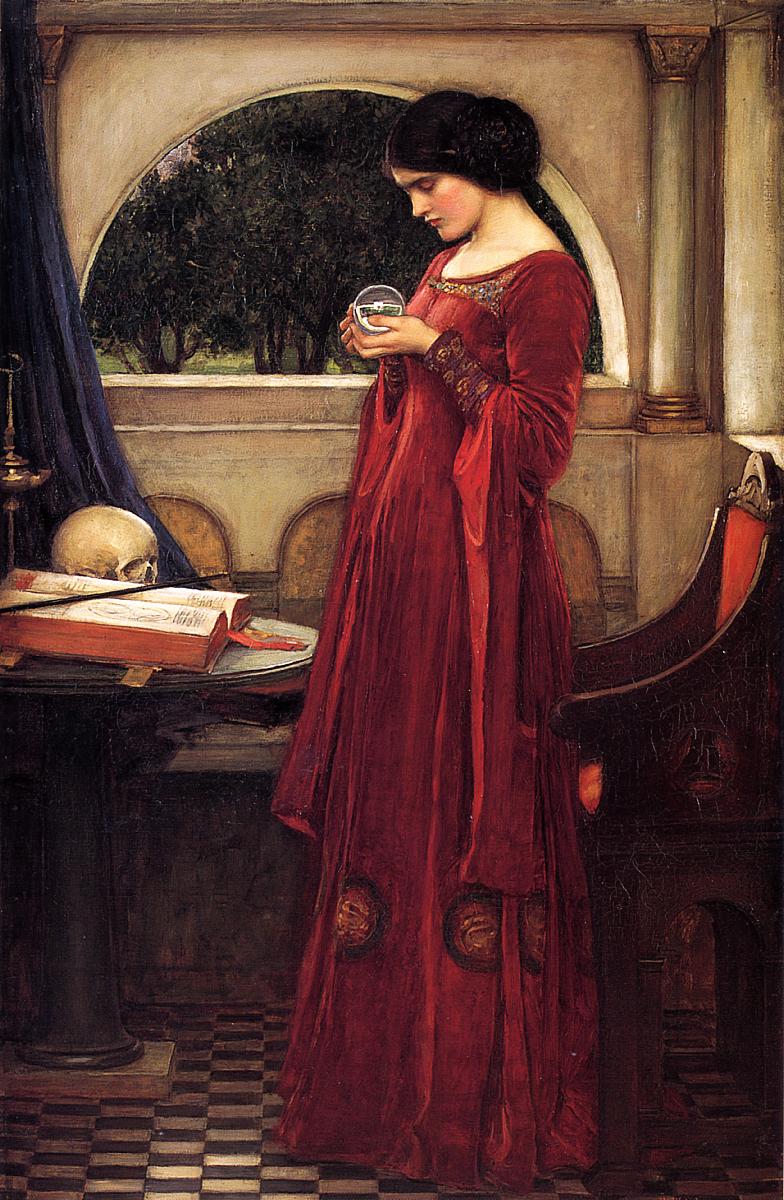
Much of the magic encountered in the stories isn't that magical either. Seidr, which is the most common magic used, is a way to both see and change the future. That means that in its most basic form, Seidr is nothing but foresight and will. It's the way we direct our lives in an uncertain world. Rather than being tossed about willy-nilly, we make plans based on expected future events.

I have repeatedly suggested on this blog that we should make a habit of making predictions so as to profit from our foresight. That, as it turns out, is to encourage the practice of basic Seidr magic.

John William Waterhouse - The Crystal Ball.JPG
Making predictions

By John William Waterhouse - http://uploads6.wikiart.org/images/john-william-waterhouse/the-crystal-ball-1902.jpg http://www.wikiart.org/en/john-william-waterhouse/the-crystal-ball-1902, Public Domain, Link

Monday, October 24, 2022

Writing Romantic Fiction

I've always wanted to write fiction. However, I've found it surprisingly difficult every time I've tried. There's too much to keep in mind, too much to invent, and too many details.

There's also the issue of style. Is the story primarily meant as entertainment or as a statement? If I want to make a point about something, I might as well write a blog post, and if it's mere entertainment it becomes tedious to write. So, I gave up on the idea, thinking that it's just a childish fancy that I'm better off ignoring.

But then it struck me the other day that I should simply base my novel on things I know a fair bit about. I'm pretty well versed in history, and I know a good deal about Norse mythology. Why not mix the two?

This has the great advantage that all sorts of details are available for me to use. I don't have to invent anything beyond the main characters and their struggles within the historic and mythological backdrop.

As it turned out, I was able to sketch out a rather elaborate story in no more than two days, and I've now started the process of fleshing out the story into chapters.

I've already written two chapters, and I hope to add a new chapter every day or two going forward.

This means that I'll spend less time writing posts on this blog. However, there will be all the more to read for those who don't mind reading light romantic literature. The interested reader can follow me at "Dreufey's Song", where the book will grow chapter by chapter until completed.

Idunn and Bragi by Blommer.jpg
Idunn and Bragi

By Nils Blommér - uploaded from Wikipedia.org, Public Domain, Link

Wednesday, October 19, 2022

Covid Strain with an 80% Kill Rate in Mice

Boston University scientists have created a new Covid strain in a laboratory by combining Omicron and the original Wuhan strain. This new strain killed 80% of the mice used in their study, according to the scientists themselves.

Apparently, there's no shame in doing this kind of research. We can therefore assume that similar work is done all over the globe, and we can further conclude that some accident will eventually happen where such a deadly strain escapes the laboratory. However, we now have enough experience with this kind of shenanigans to know that there's little to worry about.

The Wuhan flu started out dangerous but became harmless within a few months. This was clear as early as April 2020. The mortality rate dropped off a cliff from day one.

This is because viruses don't benefit from being deadly. It's better for the virus to let the host live because viruses die when their host die. The longer the host lives, the more chances there are to spread, and so we end up with the most benign versions spreading more than the more lethal ones. Natural selection kills off the deadly strains in favour of the harmless ones.

The trick to surviving the next lab leak is no different from the trick we already employed in order to survive the Wuhan strain: Avoid being among the first to catch the virus and keep a healthy lifestyle.

A roast lamb dinner at Black Horse Inn, Nuthurst, West Sussex England.jpg
A roast lamb dinner

By Acabashi - Own work, CC BY-SA 4.0, Link

The Insanity of Disbelief

When people believe in things that don't exist, we use words like delusional or gullible to describe them. In some cases, we'd say they are paranoid. A strong belief in something that doesn't exist is a sign of mental illness.

To avoid this, some resolve to believe only that which can be proven to exist. However, that turns out to be just as maddening as a belief in things that don't exists, because nothing beyond our senses can ever be proven.

If we resolve to believe only that which we can prove through our senses, we quickly end up with the problem of ascertaining if our sensory inputs are real or mere simulations. We have no way of knowing if we're living inside an advanced simulation, or inside a real world with real things.

We must, at this basic level, make a choice. We must either believe that the world around us is real, or we must believe that it's a simulation. However, only one choice leads to sanity, and that is to believe that the world around us is real.

People who partially or fully believe that only they are real, and everything else is mere scenery have no way to judge what other people think or feel. There can be no empathy in a world where only I exist. There can be no love, and no real joy. Everything becomes merely a matter of sensory inputs. We love only that which gives us physical satisfaction.

Such people are sociopaths. They don't connect to the world in a healthy way. It's all about them and everything else is secondary to their wants and desires. Such people are avoided and despised, because they have a mental illness that's not only detrimental to themselves, but to everybody else as well.

The only sane way to approach the external world is to accept three things:

  1. The world around us is real.
  2. We're no more special than everyone else.
  3. We're equipped with a free will.

Only when all three points are accepted can we conclude that the world is real and not a simulation. However, none of the above points can be proven. We have to accept them on face value. We have to have faith in the above in order to live healthy lives with love and empathy, and a sense of purpose.

This is why the above three points are central to Christian doctrine. We're told to believe in God and His creation. That's point 3 and 1 respectively. We're also told to love others like we love ourselves. That's point 2.

We're told to believe in all of this because it's the only way to live life fully.

Jesus sits atop a mount, preaching to a crowd
Jesus

Tuesday, October 18, 2022

An Irrational Insistence on Atheism

There is among many libertarians an insistence on atheism. This is irrational in that it does nothing to promote libertarian thinking. Why insist on atheism when it's so much easier to point out that Jesus was a libertarian anarchist.

Jesus accepted no law that wasn't based on the golden rule, and he accepted no authority other than God. Jesus was in other words a man who believed in natural law.

There's nothing in Christian doctrine to stop Christians from embracing libertarian anarchy. On the contrary, belief in political authority is distinctly un-Christian in that it gives some men the authority to define what's good and what's evil.

Those who insist on atheism are generally of the opinion that they are the rational ones, and that their insistence is merely an insistence on rationality. They want to convert Christians away from their irrational belief in God. However, there's nothing irrational about a belief in God. The reason for this is that there's no way to explain the phenomenon of free will without invoking some universal will present in nature.

Natural sciences see the world as part mechanical and part random chance. Hence, we're nothing but automata with a sprinkle of randomness. We have the appearance of free will, but no real power to change anything. Everything is quantum-mechanics. No physical outcome can be changed through our will, because no will exists. Will is not a physical concept.

But if this is the case, why spend any time arguing for liberty? If there's no will, we might as well spend our time doing other things.

To get around this, the atheists Arthur Schopenhauer insisted on the existence of a will, everywhere present in nature. Since we are part of nature, we have a will, and we can therefore change the outcome of events.

But how is this different from believing that God has given us free will? The concept of a will is no less metaphysical than the concept of God.

Furthermore, if a day comes when the concept of a will is successfully incorporated into the natural sciences, we're no closer to a resolution on the issue. Such a discovery can be used just as much as an argument for God's existence as for the opposite.

If God is a will everywhere present in the universe, the discovery of this will is no proof against God.

To insist that there's no God and at the same time insist that we have a free will makes no sense, because God can be defined as a will present in the universe. To insist that there's no free will makes even less sense, because a world without free will is a quantum-mechanical machine where no outcome can be changed by our will. Why insist on anything if the outcome is merely a mix of mechanics and random chance?

Without free will, there can be no moral judgements, no room for wilful change, no purposeful action. Life becomes meaningless, and liberty impossible.

Libertarian doctrine is based on the idea that we're equipped with a free will. Free will is in turn linked to the idea of a will present in nature, aka God. It's therefore irrational for a libertarian to insist on atheism, because atheism rejects the existence of the metaphysical entity that forms the basis of libertarian doctrine in the first place.

Michelangelo - Creation of Adam (cropped).jpg
Creation of Adam

By Michelangelo - See below., Public Domain, Link

Colds and Lung Infections

My brother-in-law has caught another cold. It's never-ending it seems. Ever since he got himself vaccinated it's been one thing after another. Pains and aches, covid, colds. All sorts of ailments. However, it could've been worse. He could've had a heart attack like his older brother, or recurring lung-infections, like my cousin's six-year-old daughter.

My cousin and his wife decided to get their daughter vaccinated in order to go on vacations during the virus scare. Instead of waiting a year to see what the side-effects of the vaccine might be, they decided to risk it on themselves and their little girl. The girl has had double-sided lung-infections twice so far and is currently on oxygen treatment in a hospital.

The flu season has not even started, and we're already seeing people getting seriously ill with colds and lung-infections. Needless to say, my wife and I are glad we didn't cave into the relentless peer pressure that we were under back in the summer of 2021.

Simple face mask.jpg
Oxygen treatment

By James Heilman, MD - Own work, CC BY-SA 4.0, Link