Thursday, September 1, 2022

871 Cases of Monkeypox in Portugal

A total of 871 cases of Monkeypox have been registered in Portugal as of August 31. This translates to about 4 new cases per day over the last week. This is the smallest number registered since the spread of the disease stalled in July:

  • July 1 - 415 cases - about 10 new cases per day
  • July 7 - 473 cases - about 10 new cases per day
  • July 13 - 515 cases - about 7 new cases per day
  • July 20 - 588 cases - about 10 new case per day
  • July 27 - 633 cases - about 7 new cases per day
  • August 3 -710 cases - about 10 new cases per day
  • August 10 - 770 cases - about 9 new cases per day
  • August 17 - 810 cases - about 6 new cases per day
  • August 24 - 846 cases - about 5 new cases per day
  • August 31 - 871 cases - about 4 new cases per day

Assuming a hospital stay of no more than ten days for the infected, there should be no more than 40 cases of Monkeypox in Portuguese hospitals at the moment.

Original eight-stripe version designed by Gilbert Baker (1978)
Pride flag

By Gilbert Baker (Vector graphics by Fibonacci) - SVG based on this image, Public Domain, Link

Gold Testing Support Again

The price of paper gold broke below $1,700 per ounce again today. We're back to where we were six weeks ago when it bounced from $1,680 up to $1,800.

Having almost reached $2,100 back in March, this is disappointing. It's also a little unnerving because the bounce was without much conviction. We're stuck in a down trend that has lasted five months. However, there's still massive support at around $1,670, as can be seen in the monthly chart. We can also take comfort in the fact that the price of physical gold has hardly budged since the peak back in March.

My local gold dealer, which used to have some forty different gold products for sale is down to ten products. Their 10 gram wafer sells for €588, down only 4% from €612 back in March. Physical supply appears to be tight, and margins wide.

But the situation is precarious. The Fed is acting tough, and people are flocking to safety in cash. This impacts all markets. But some markets are more influenced than others. Stocks are likely to go down faster than the price of gold in the event of a crash. That means that those holding gold will be relatively better off.

The big winners in the event of a crash are always the ones holding cash. However, cash is a more precarious position than gold. The Fed can suddenly start printing money again. Gold, on the other hand, can only be manipulated so far before something breaks.

The best position right now, with stocks and real-estate priced at elevated levels, is a mix of gold and cash, as recommended in my book.

Monthly Gold Chart Captured on July 14

Mistaking the Market for the Economy

In a free market economy, the market is the economy. There's no distinction. However, in a regulated economy, the market deviates from the economy. Prices no longer reflect underlying demand and supply. They reflect tings like, licences, central bank credit, and central bank lending rates. The more regulated and manipulated the market is, the more it deviates from the underlying economy.

This means that it's a mistake to look at markets in order to divine what may be going on in the economy. Yet, this is precisely what the elite tends to do. They are so tied to the fluctuations of markets that they've come to see it as their lifeblood, and the lifeblood of everyone else. They are therefore likely to misinterpret reactions to tighter financial conditions.

When the elite sees prices of stocks and real-estate go down, they assume that this must hurt the little guy. They are themselves exposed to the pain, and assume that those smaller than them must feel the pain all the more.

This impression is strengthened by stories about ordinary people getting caught in the net. Such stories abound in times of financial tightening. There's no lack of people who borrowed too much. The impression is that just about everyone is bankrupt.

The sadistically inclined may then conclude that the pain to them is worth it, and that the tightening should continue. As long as there are stories about people in even more pain, they tolerate the increased pain to themselves. However, they aren't being told the full story. Not every little guy is suffering. Only those deep in debt are in trouble. Prudent savers see their purchasing power strengthened by the day.

The irony in this is that sadists may inflict great damage to themselves in the mistaken belief that they are hurting others all the more. But the only ones hurt are themselves, and those they tricked into their web of lies. People beyond their reach will thrive, and the gap between rich and poor will become smaller.

Grand-Bazaar Shop.jpg
Grand-Bazaar

By Dmgultekin - Own work, CC BY-SA 3.0, Link

A Bamboozle Too Far

Central bankers everywhere are determined to cool down the global economy. The idea is that people have too much money in their hands, and that an increase in unemployment is required in order to stop them from spending it in such a way that prices rise.

The assumption is that higher interest rates destroy jobs, so central bankers are raising rates. However, this assumption is based on one of Keynes' fallacies. It assumes that it's first and foremost credit that drives job creation. But that's not how it works.

Employment requires capital investments, and capital investments require a material surplus in the economy. Credit conjured out of thin air does nothing to boost this surplus. Only real savings provide this type of surplus. Someone has to forego current consumption for capital to be accumulated.

An example taken from one of Irwin Schiff's books illustrates this: Imagine someone living on an island, catching fish by hand in order to survive. That person will have to set aside a few fishes in order to spend time making a net. The savings required have to be real fishes, not some fish credit from a central bank.

When applied to a large economy, this logic implies that someone has to forego a few fishes in order to produce a fishing vessel.

Credit conjured out of thin air doesn't equal real savings. It only serves to rise prices.

When we combine this insight with the fact that rising interest rates makes it more interesting to save for the future, we get a situation where people do in fact set aside a few fishes more than they otherwise would have if interest rates had been lower. They forego the current fish dinner in the anticipation that they will have an even bigger fish to enjoy a few months later. The fish foregone can in turn be consumed by someone working on a capital investment project.

With more real savings in the economy, there's more room for real investments. This means that the likely effect of higher interest rates is that prices of things will come down, and that capital investments will go up. The net effect of this will be more employment and more money in the hands of the working class.

If the intent of the central bankers is to whack the little guy with higher interest rates, the ploy will backfire. The only little guys getting hammered by higher interest rates are those who've gone all in on debt and speculative assets. However, the average saver and labourer will be fine.

Assuming that there's evil intent behind the current rise in interest rates, we have an example of evil getting entangled in its own web of lies. The bamboozle has gotten to the point where the devil is starting to believe it himself. When he acts with the intent of doing harm, he ends up doing good.

Klaus Schwab WEF 2008 (cropped).jpg
Klaus Schwab

By Copyright World Economic Forum (www.weforum.org) swiss-image.ch/Photo by Remy Steinegger - https://www.flickr.com/photos/worldeconomicforum/2296517249/, CC BY-SA 2.0, Link

Arguing for the Devil

Evil has a way of tricking us into arguing on its behalf. A false premise is presented as truth, and people start arguing based on it. The premise is thus cemented as truth in everyone's mind, and much damage is caused as a consequence.

Mask mandates in schools is an example of this. When this was argued for, it was accepted by many that masks work. Masks were already mandated in public spaces. It was therefore logical to extend this to schools and schoolchildren. The argument was focused on the latter part. The logic of it spoke for itself.

As a result, thousands upon thousands of school children were forced to wear a mask on their faces. The devil won because people decided to accept his premise.

Similarly, people inflict harm to their own best interest by arguing for policies that serve the elusive common good. Destructive monetary policies are implemented based on the assumption that everybody somehow benefit despite obvious disadvantages to ourselves.

This is why we should always scrutinize the premises before engaging in any kind of argument. If the premises are dodgy, we should stay away from any argument based on them. With just about every generally accepted premise being dodgy at best these days, we should simply stop arguing altogether.

Only when we meet people who agree with our premises, or are willing to accept them for the sake of argument, is there any hope for a constructive dialogue. In all other cases, we're better served by keeping quiet. We can provide some undeniable fact to the conversation. We can make predictions. But we shouldn't argue one way or the other. It's futile and counterproductive.

The current state of confusion that exists in society today is due to a constant stream of false premises. When accepted, even smart people get bamboozled. They end up injecting their kids with mystery serums, investing in things that are heavily taxed and sweating night and day for the common good.

Baphomet.png
Baphomet

By Eliphas Levi - Eliphas Levi, Public Domain, Link

Wednesday, August 31, 2022

Propaganda is an Offensive Weapon

Propaganda is a tool. As such, it's neither good nor bad. It only becomes bad in the hands of bad people. However, the people most interested in propaganda are people with a lust for power, which makes propaganda more commonly connected to evil than to good. We get the impression that propaganda is evil, that we must protect ourselves from it, and never resort to using it ourselves.

But a defensive strategy towards propaganda is ineffective at best. Constantly trying to find lies hidden in stories is not getting us anywhere, especially if we don't have a clear world view against which we can define truth.

To defend ourselves against propaganda, we need to have our own world view because propaganda promotes world views. Without a solid world view of our own we're powerless against it. Our world view becomes whatever the most effective propaganda tells us that it is.

When done well, propaganda forms an ubiquitous set of ideas that together form a consistent whole. This becomes in turn the dominant world view of society. There may be lies everywhere. But they fit so neatly together that the overall impression is truth. Even smart people can end up believing that democracy is freedom, that the state is us, that politicians have our best interest at heart, and so on.

However, to be truly effective, our word view must not only be consistent. It must reflect the truth, and this is where nature, aka God, comes in on the side of those who want to stand up to the evils propagated through state sanctioned propaganda.

Armed with a good world view, we can do more than just defend ourselves against propaganda. We can use the tool ourselves to promote the better world view.

My particular world view is anarchy based on Christian values. I believe that the golden rule is all we need for a functioning legal system, and that Jesus was right. There's no conflict between the teachings of Jesus and my world view.

An interesting aspect of Jesus' teachings is that he lays out the path forward when it comes to the spread of his message. He tells us how to use propaganda to promote Christian ideas. He tells us to focus on love, hope and faith. This optimistic message should be promoted wherever we go.

To defend ourselves against evil, we must never accept narratives that demoralize our efforts. Defeatism should be countered and ignored. Such ideas are for losers. They are not for us.

Our message should focus on everything good, including personal success. We need to be the person we'd like to see in the world. But the message must never be about us. We're not successful due to some personal cleverness. Rather, our success is due to our world view.

Furthermore, success isn't limited to material gains or power. That's part of the lie that we aim to expose. Any kind of personal victory is a success. Overcoming an illness is just as much a success as a fine career. Being content in our lives is better than being constantly striving for more material wealth.

The point of our propaganda isn't to come across as better or more wealthy than we are. That would be lying. Our propaganda should be truthful. Step one is therefore to live the lifestyle that we promote, and to apply our chosen world view in all our affairs. Only then does it makes sense to study Edward Bernays's Propaganda and similar texts for useful insights into how propaganda works.

Liberty
Liberty

Tuesday, August 30, 2022

Never Think, Talk or Act in Terms of the Common Good

Politicians like to think of themselves as representatives of the common good. They invoke some cause or other that requires everyone to make a sacrifice. We have to pay taxes, follow rules of various kinds, and generally do as we're told. It's good for society, they say. Or they point to the children or old people, or some other group.

This was on full display during the virus scare. We were told to lock down, wear masks and take experimental drugs, all for the common good. If anyone asked specifically what it was all about, we were told that it was for grandma's sake. To disobey was tantamount to murder.

The folly of this is becoming increasingly obvious in retrospect. However, most people think the error lies in the misidentification of the common good. They don't realize that the very idea of a common good is where the error lay. This is evident in the way things continue to be discussed.

An example of a topic that's rarely talked about in any other context than the common good, we have money in the context of monetary policies. I have yet to see anyone discuss this without invoking some common good like society or nation.

People will argue for or against the gold standard without ever mentioning their own personal preference. They cite the need of policy makers to be flexible, or the need for credit to stimulate economic activity. Rarely, if ever, does anyone argue the point from a personal perspective. Yet, this is precisely the way we need to look at things if we aren't going to be duped by some central banker or other.

The question we have to answer for ourselves is whether we would prefer to be paid in gold or in paper money. Do we prefer to use gold or paper money when budgeting and accounting? Is gold better than paper money when it comes to judging long term price fluctuations?

If we answer these questions honestly, the only reason we'll come up with in favour of paper money is that everyone else is using it, so we have to use it ourselves. But that's not an argument for anything. It's merely a statement of facts.

The only correct way to think about society is to ask ourselves what's in it for us. If there's no benefit to us, why go along with some scheme or other?

This attitude will cause many to react in horror. However, this is only due to ignorance as to what it means to act in our own self interest. Fair trade is in our interest because it benefits both parties in the transaction, so self interest doesn't exclude us from productive cooperation in society. Sinful activities result in trouble for ourselves, so such activities are not pursued when we have our best interest at heart.

The only acts we exclude ourselves from when we refuse to think in terms of the common good are those that impact negatively on ourselves for some perceived benefit to someone else. To refrain from such harmful actions towards ourselves isn't immoral. It's the only rational way to act.

Some will at this point bring up the "trolley car dilemma". This is a favourite among politicians who like to think of themselves as constantly at the levers of this kind of machine. However, the problem has a solution that has nothing to do with the common good.

When having to choose between saving one or saving many people, we'll instinctively choose to save as many as possible. This isn't due to some abstract ethical ideal. It's because we like to have as many friends as possible. By saving a bunch of people, rather than saving just one, we end up with more friends.

This response will elicit all sorts of outrage. However, we can respond to this quite easily. We can counter the question by asking what they themselves would do if it was their spouse who was the single person in danger. We can further inform them that we intend to share their answer with their spouse.
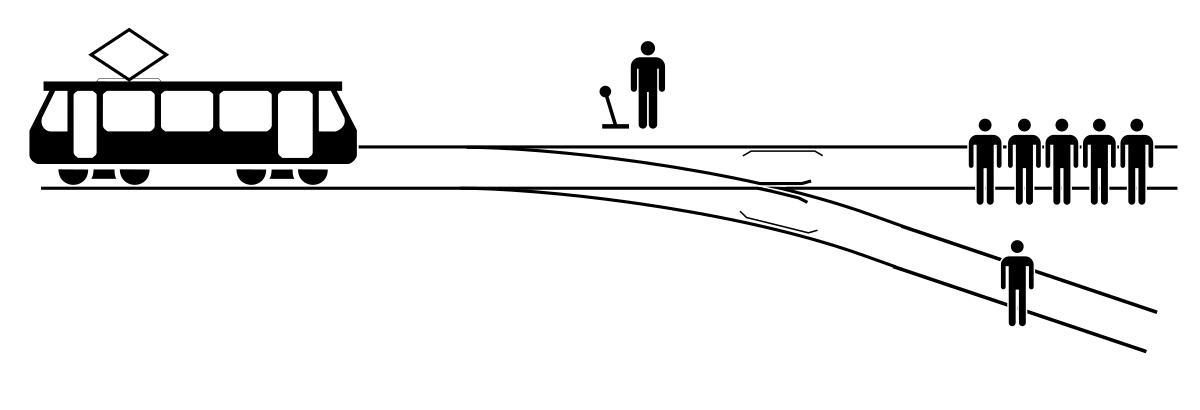
Trolley Problem.svg
Trolley car dilemma

By Original: McGeddon Vector: Zapyon - This SVG diagram includes elements that have been taken or adapted from this icon:, CC BY-SA 4.0, Link